Instruction
The first step in providing an assistive product is to assess the person’s needs and help them select the most appropriate device.
TAP Vision screen
The first step in assessing if a person may need near vision spectacles is to complete the TAP vision screen (or a similar vision screen).
If results from the vision screen show that near vision spectacles may help, you can then assess the person for near vision spectacles.
Warning
It is only appropriate to assess a person for near vision spectacles if they:
- Passed the eye health check and do not have any signs of an eye health problem
- Passed the distance vision test
- Did not pass the near vision test
- Are 40 years or older.
Always make sure that any other referrals indicated by a vision screen are carried out.
Question
Alice is 50 years old and does not have any eye health problems. She passed the distance vision test, but did not pass the near vision test. Would you assess Alice for near vision spectacles?
Yes, because she:
- Has no eye health problems
- Is older than 40 years
- Passed the distance vision test
- Did not pass the near vision test.
Instruction
Read on to see how to select the correct near vision spectacles for someone.
Which power?
Use the near E-Chart to help find the best power of near vision spectacles for each person.
Activity
Look at the near E-Chart.
Note that the chart has one row of five Es (standardized font size N6).
How many of the five Es can you see clearly?
Method:
1. Ask the person to hold the near E-Chart in front of them. If they cannot hold it easily, you can hold it for them. The distance between the E-Chart and the person’s eyes should be approximately 40cm, or the distance they will be doing the activity that they would like near vision spectacles for.
2. Ask the person to look with both eyes at the chart. Check that they can see this row clearly by asking them to tell you which way the legs of each E are facing.
3. If the person cannot see the row clearly (3 or more Es), ask them to put on the lowest power of near vision spectacles (+1.00). With these spectacles on, test again with the E-Chart.
If the person cannot see the Es clearly, try the next stronger near vision spectacles. Keep trying different powers until the person can clearly see 3 or more Es.
4. Then, ask the person to check if they can still see the Es with the chart a little further away or slightly closer. Ask them to move the vision chart back and forth within a range of around 20cm.
You can also ask the person to read a newspaper with their new spectacles. For some people, it may not be possible to find the correct near vision spectacles. If this happens, refer them to an eye health professional for further assessment.
Remember Rashid?
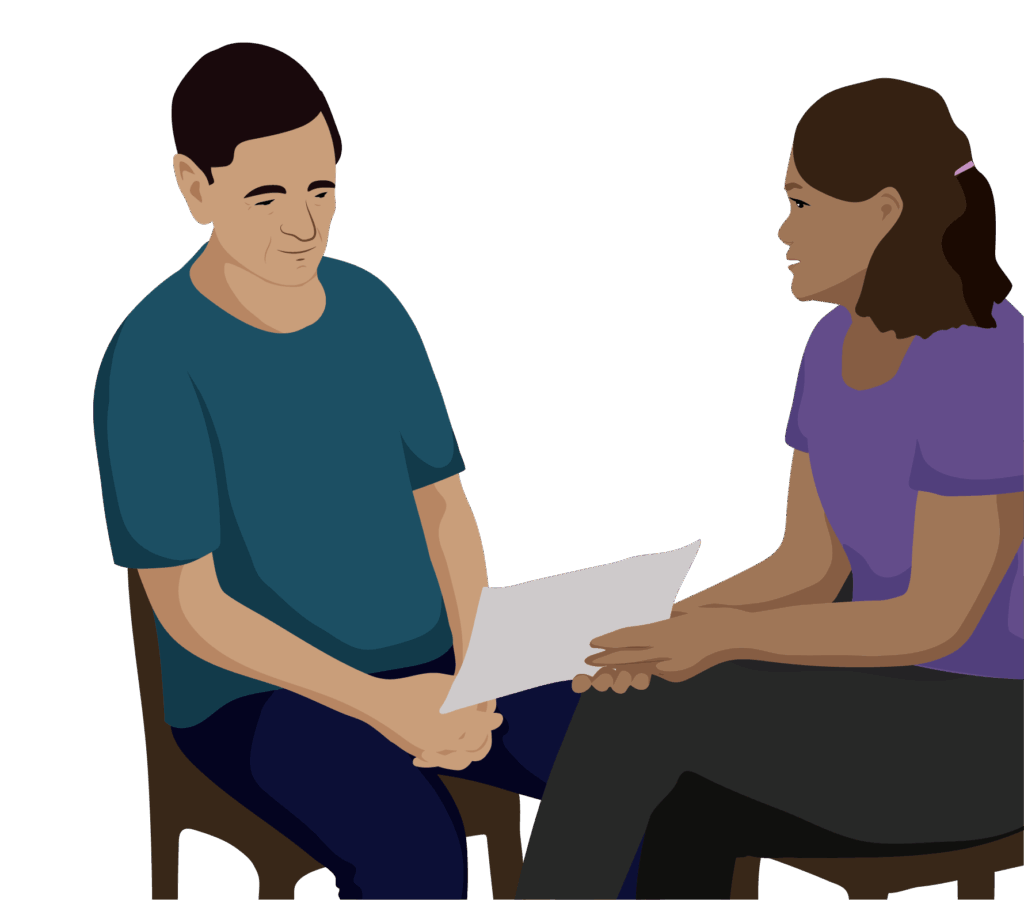
To find the correct power of near vision spectacles for Rashid, his health worker followed the steps above.
When looking at the near E-Chart, Rashid could not see the row of Es clearly. His health worker gave him the lowest power near vision spectacles (+1.00) and asked him to try again. Rashid still could not see the row of Es clearly, so the health worker gave him the next strongest spectacles to try (+1.50). Rashid could see the row of Es clearly with these near vision spectacles.