This section of the assessment form will check the:
- Risks when using the transfer board
- Ability of the person to transfer
- Abilities of the person when sitting
- Surfaces where the person has difficulty moving to/from
- Features of their wheelchair that may affect selection of transfer board.

Pressure wounds
Ask: Do you have pressure wounds on your body (such as hips / buttocks / back?)

A pressure wound is a serious health risk.
Always ask the person if they have any pressure wounds. If yes, with their permission refer the person to a health professional.
Question
What else can you suggest to the person if they have a pressure wound?
If you selected a, b and c, you are correct!
It is very important to avoid pressure on a wound to help it heal. Changing position when lying down helps distribute pressure across different parts of the body.
A person should check their skin daily and go back to the health professional if the wound is getting worse.
d is incorrect.
Wound dressings can help but a wound will not heal if the person does not avoid pressure on the wound.
If you did not answer this question correctly, refer back to what you learned about pressure wounds in Lesson three of the TAP Mobility Assistive Product module.
A pressure wound that does not heal is a serious health risk. Early management is important to prevent pressure wounds from progressing.
If a person has a pressure wound, some transfers might be essential. For example, to allow a person to move from their bed to the toilet.
Ability to transfer

Children, adults, and older people can have difficulty transferring for different reasons.
Ask the person different questions about their ability so you can find out more.
Difficulty standing or not able to stand
Ask: Do you have difficulty standing or are you not able to stand?
If a person has difficulty standing/is not able to stand, or has been asked to avoid taking weight through one or both legs, they may benefit from using a transfer board.
Pain when transferring
Ask: Do you have pain when transferring?
If a person has pain when standing, they may benefit from using a transfer board.
If a person has pain in their arm or hand when transferring sitting down, they may benefit from using a transfer board to move in smaller lifts.
Question
How may a transfer board make it less painful for a person to transfer?
Select all that apply.
If you selected b and c, you are correct!
Lifting in small lifts with a transfer board puts less strain through legs and arms. This can reduce pain and help healing.
a is incorrect.
A person can take time to think about a transfer without a transfer board.
Risk of falling
Ask: Do you worry about falling when standing or have you fallen more than once in the past year?
A person may have difficulty standing or balancing and worry about falling. They may feel safer transferring using a transfer board.
Question

Remember Verna?
Verna is frail and worries about falling when getting up to transfer from her bed to the toilet chair at night.
She finds it hard to stand and step from the bed to the toilet chair. Sometimes Leif has difficulty assisting Verna to transfer standing up.
Is Verna at risk of falling?
Yes is correct!
Verna worries about falling when standing at night and her husband Leif sometimes has difficulty assisting Verna to stand up.
Verna may feel safer transferring sitting down with a transfer board.
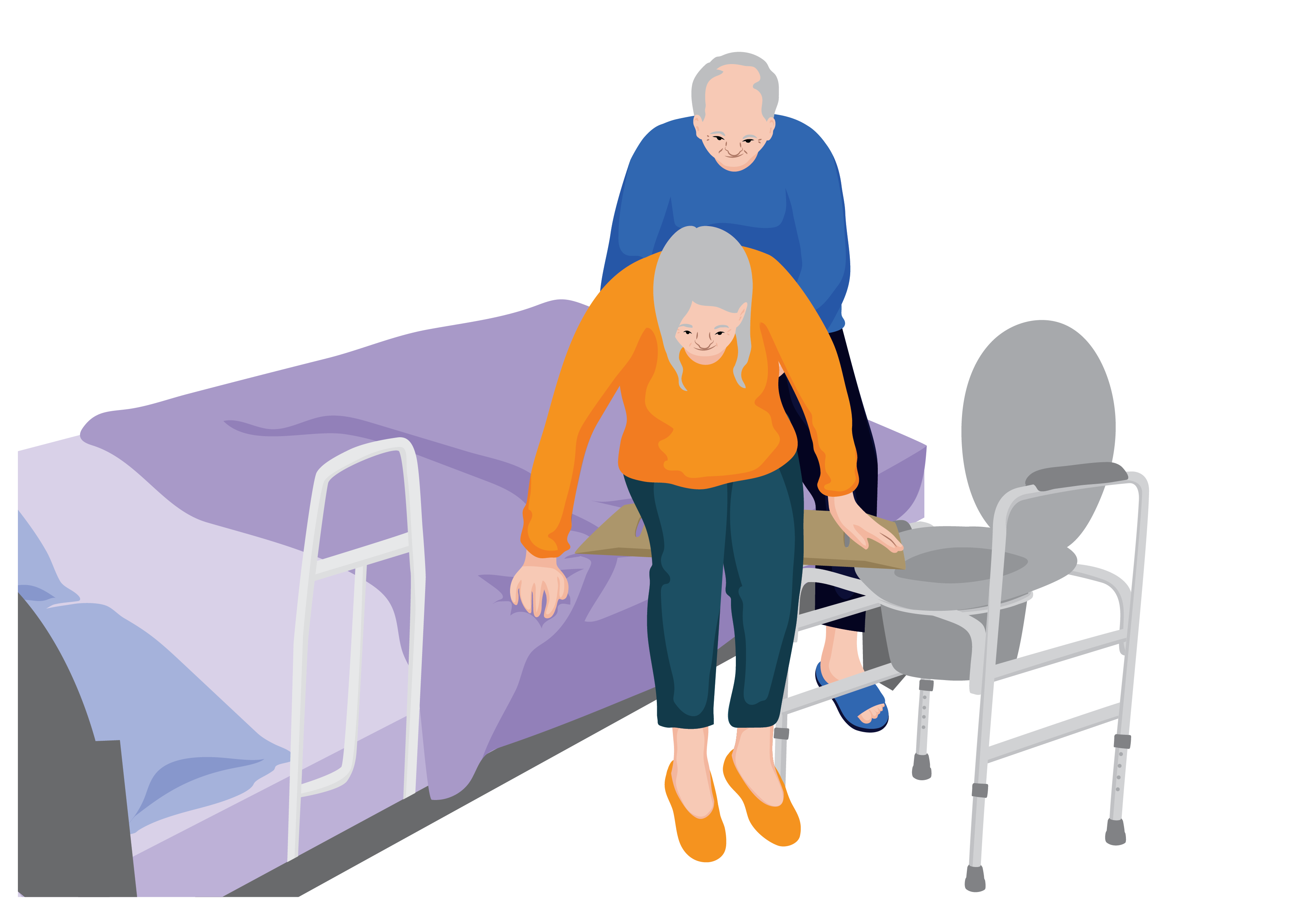
Verna tries using a transfer board with assistance from her husband Leif.
They both feel safer and Verna is confident about moving from the bed to the toilet chair at night.
Ability when sitting
Asking questions about a person’s ability to transfer when sitting will help decide whether to teach the person to transfer with or without assistance.
If a person has difficulty with any of these activities, they will benefit from assistance while transferring.
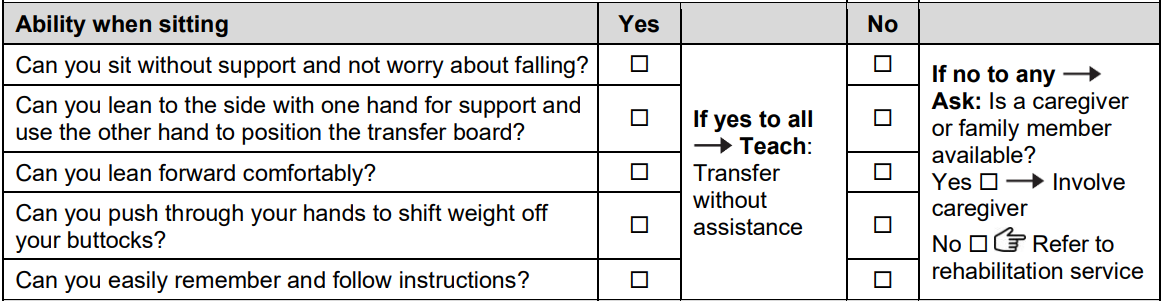
If the person is unsure whether they have difficulty with a specific activity, it may be helpful for them to show you. For example, leaning forward.
Sitting without support
Ask: Can you sit without support and not worry about falling?
A person may have difficulty sitting without support due to:
- Difficulty with balance; or
- Experiencing sudden uncontrolled movements.
Question
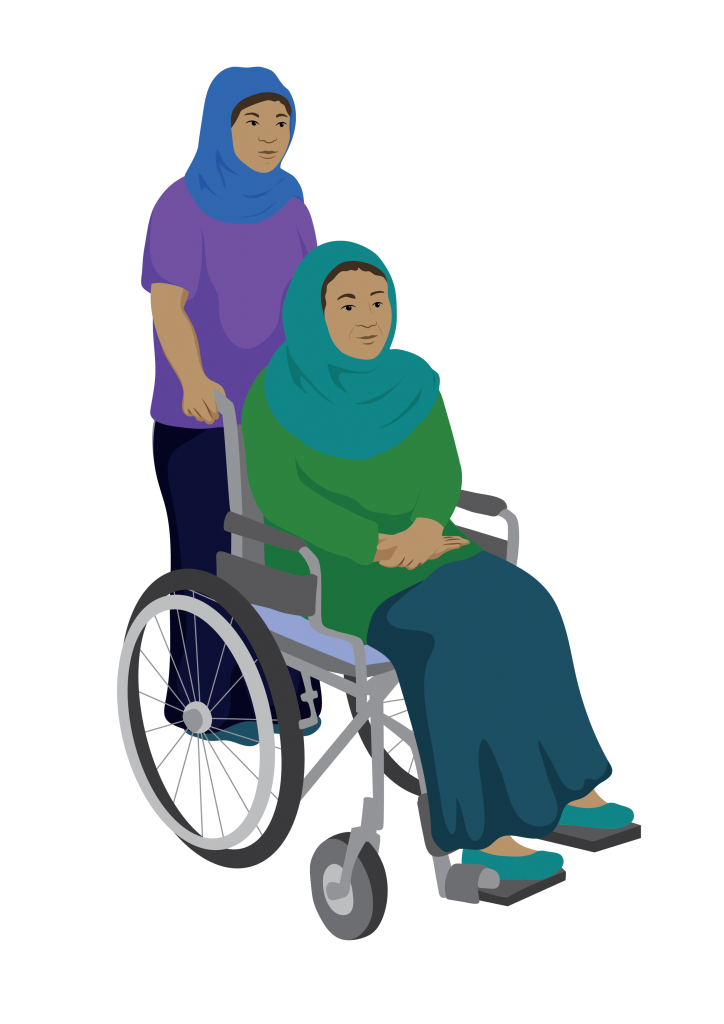
Remember Maria?
Maria has multiple sclerosis, which is a health condition that affects the nerves in the brain and spinal cord. She uses a wheelchair to move around. Maria’s daughter Lisa assists her.
Recently, Maria is experiencing sudden uncontrolled movements in her legs while transferring. She is worried she might lose her balance and fall.
Can Maria sit without support and not worry about falling or sudden uncontrolled movements?
No is correct!
Maria experiences sudden movements of her legs which she cannot control. She is worried she will lose balance and fall. Teach Maria to transfer with assistance.
Preparing to transfer
Ask: Can you lean to the side using one hand for support and use the other hand to hold and position the transfer board?
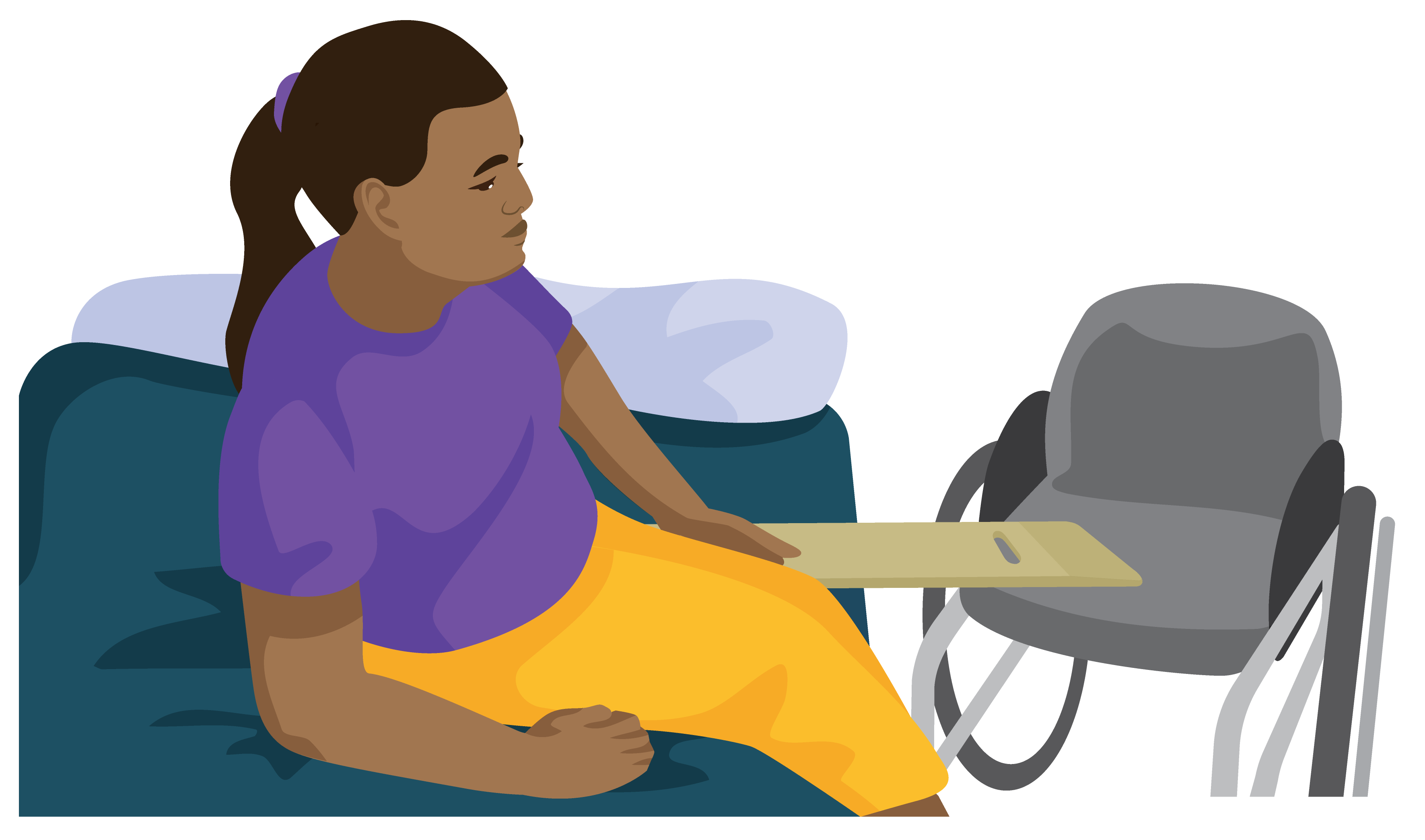
A person uses both hands when preparing to transfer. They lean to one side using one hand for support. Then they use the other hand to position the transfer board in place.
The same skill is used to remove the transfer board when the transfer is complete.
Question
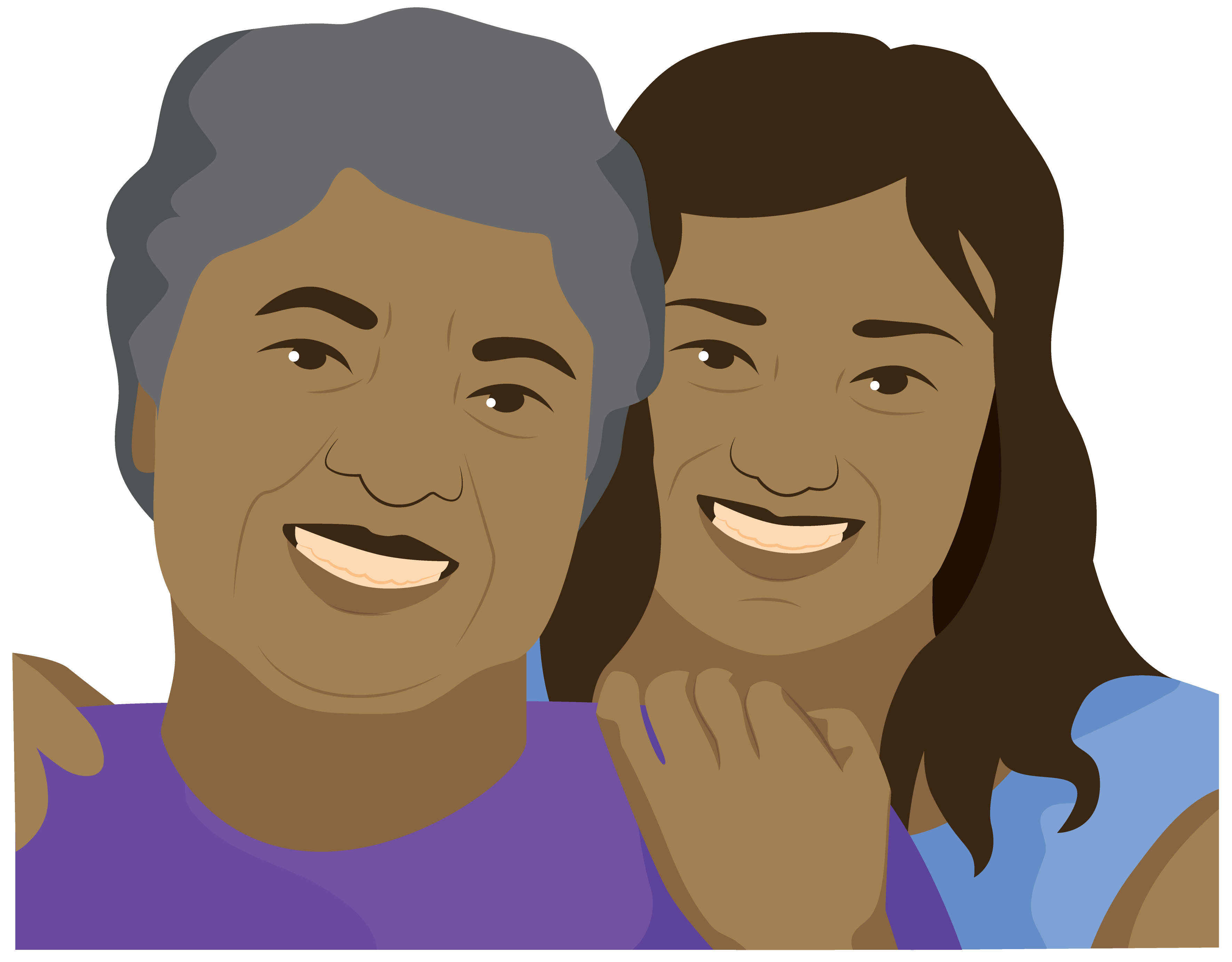
Meet Beatrice
Beatrice is 60 years old and recently had a stroke. She lives with her daughter Joanna.
Beatrice has weakness in her left arm and leg and finds it difficult to stand. This makes her worry about falling.

Beatrice uses a transfer board. Her daughter helps to position and remove the transfer board while Beatrice leans to one side using her right hand for support.
Which parts of this activity can Beatrice do herself?
Select all that apply.
If you selected a, you are correct!
Beatrice is able to lean to the side to make it easier to position the transfer board under her buttock.
b and c are incorrect.
Beatrice is not able to use her arm to hold or position the board under her buttock. Her daughter Joanna assists her.
Lifting weight off buttocks
Ask:
- Can you lean forward comfortably?
- Can you push through your hands to shift weight off your buttocks?
Leaning forward and pushing weight through both hands shifts weight off a person’s buttocks. This is an important first step to make it easier to lift.
The ability to lift weight off buttocks is important for a person to avoid dragging their skin while transferring.
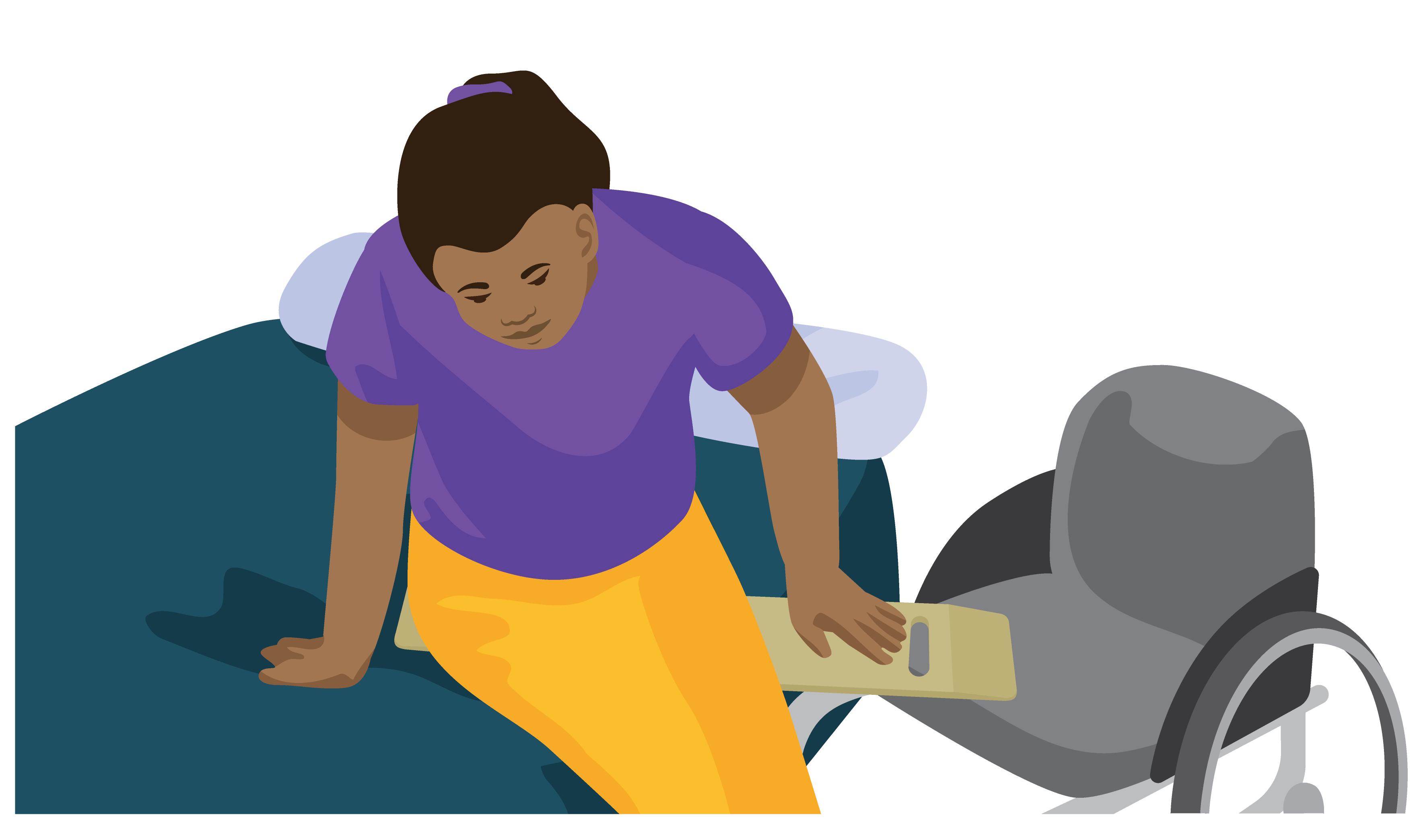
Lifting on to the board
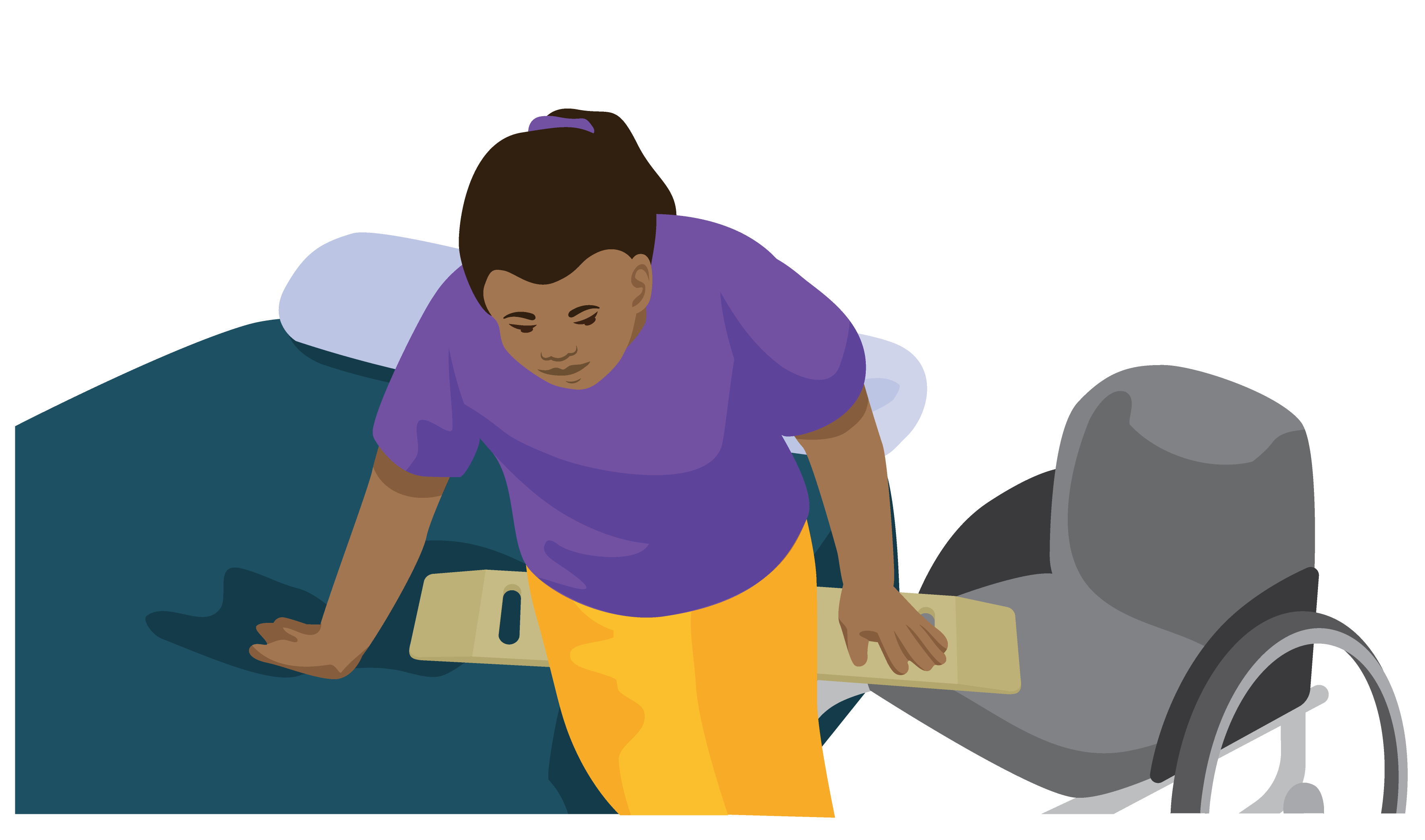
Lifting across the board
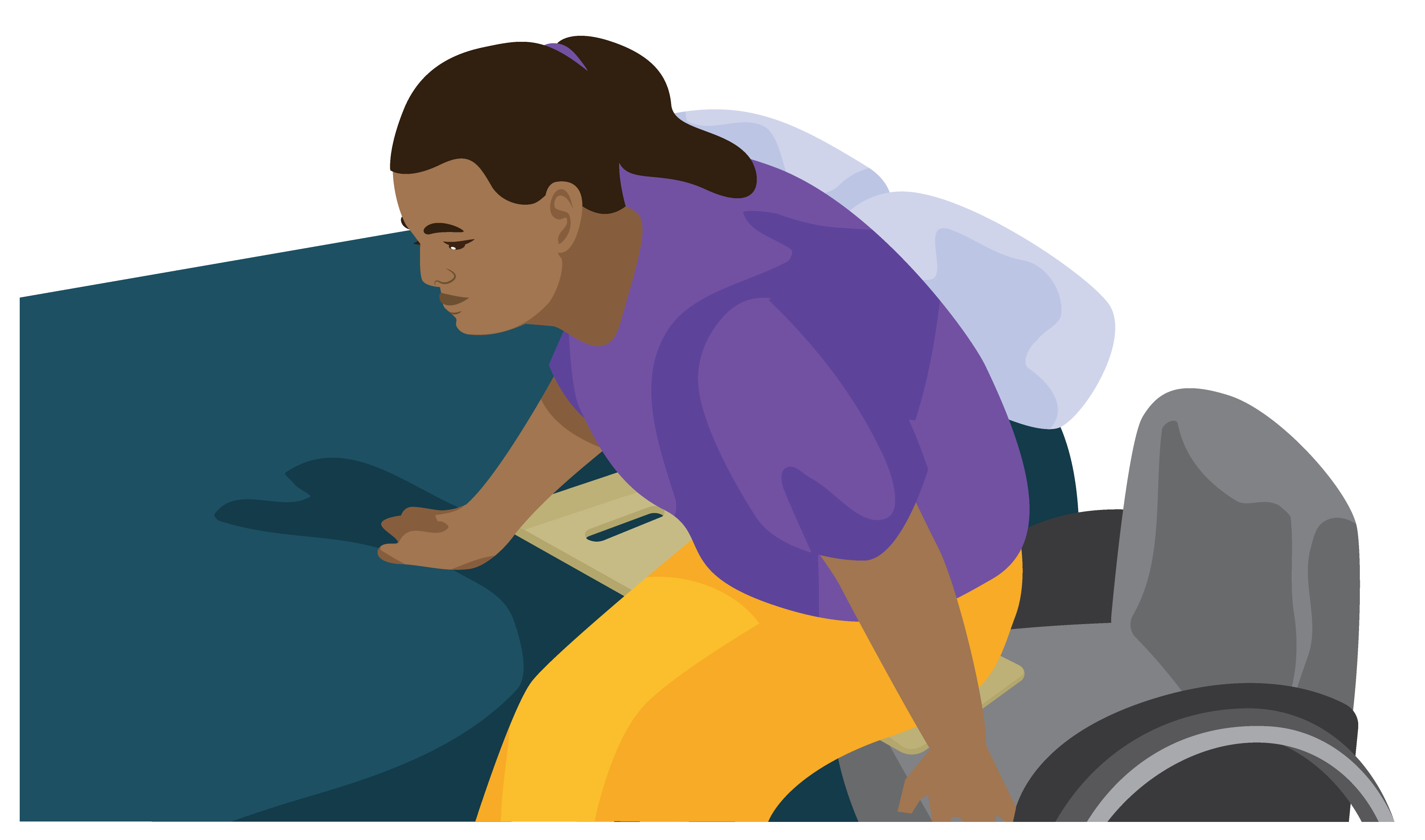
Transferring to the wheelchair
Activity
Try sitting with your feet on the ground and pushing through your hands to lift your buttocks.
Do not allow yourself to lean forward.
Then repeat and allow yourself to lean forward while you push through your hands to lift your buttocks.
What difference do you notice?
- The weight feels less
- It is less effort
- It takes less strength in the arms.
Remember Verna?
Verna can lean forward but needs Leif’s assistance to do small lifts to move across the transfer board.
Remembering and following instructions
Ask: Can you easily remember instructions and follow them?
Good memory and being able to understand instructions are important when learning how to use a transfer board safely and effectively.
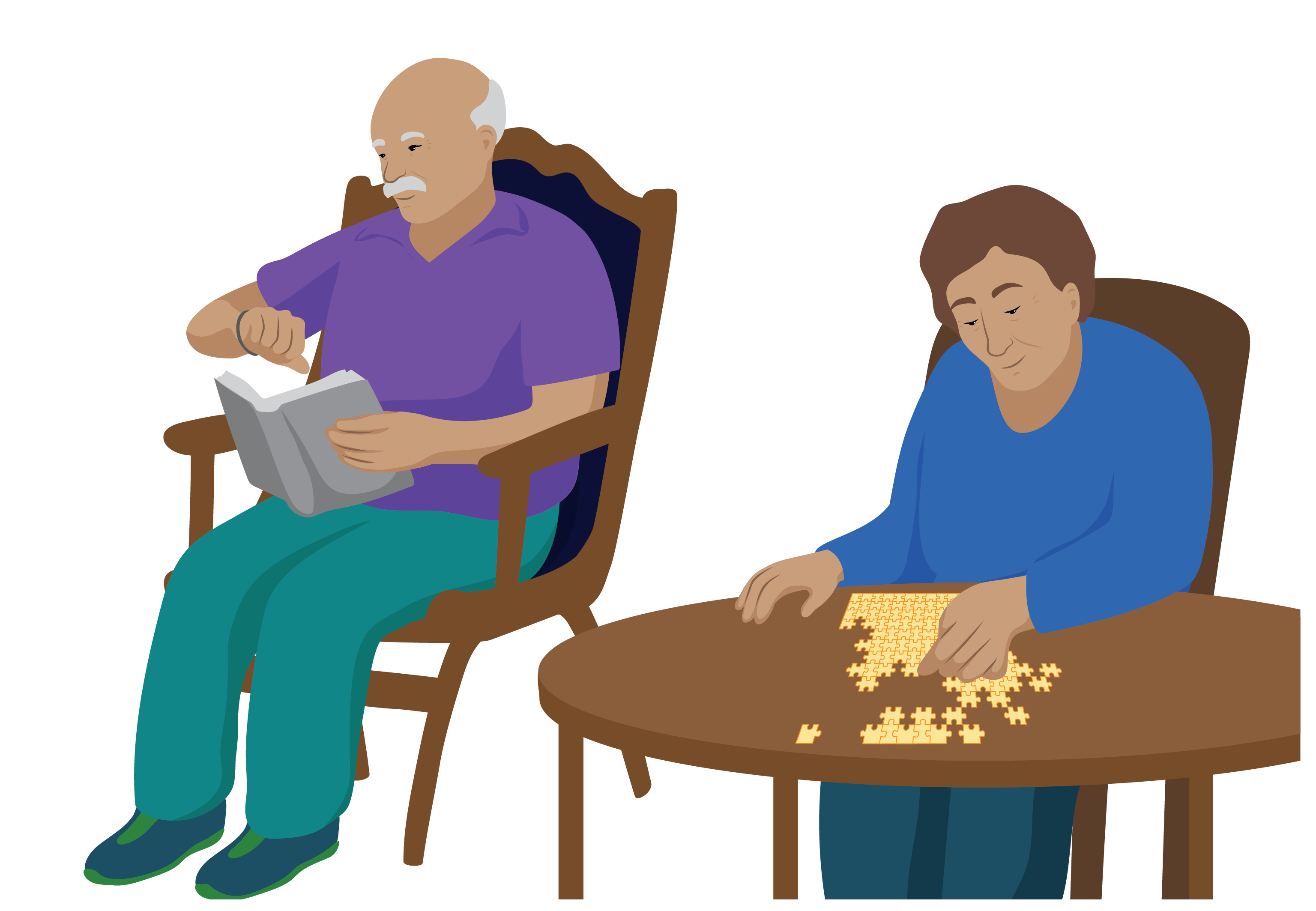
Meet Luciana
Luciana is 73 years old and lives at home with her husband Jose. Luciana has difficulty remembering and planning activities. Jose assists Luciana by reminding her.
Luciana may benefit from assistance when planning how to use a transfer board.
Work through the activity to practice completing the ability when sitting section of the assessment form.
Activity
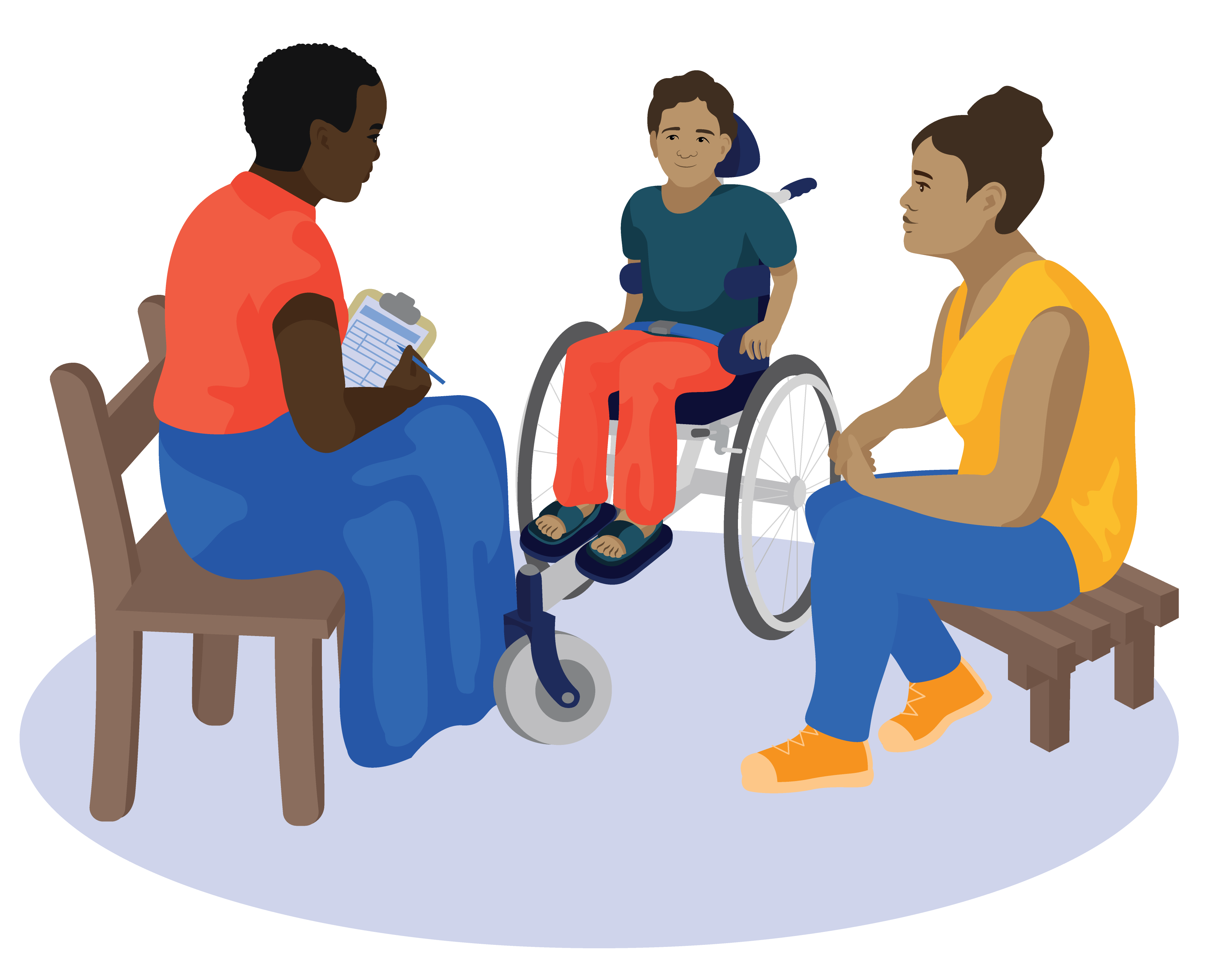
Remember Firoz?
Firoz came to the assessment with his mother. See the summary of Firoz’s response to the ability when sitting section below.

How will you teach Firoz to use the transfer board?
Transfer with assistance is correct!
Firoz did not respond ‘yes’ to all the questions on ability when sitting. Teach Firoz to use the transfer board with assistance from his mother.
Is assistance available?
Ask: Is a caregiver or family member available?
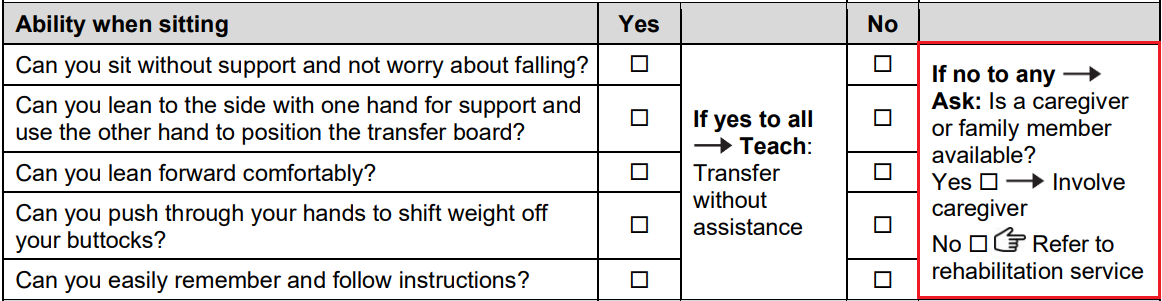
If a person needs assistance to use a transfer board safely, it is important to check that they have a caregiver who can assist them.
If a person needs assistance when transferring but does not have a caregiver available or the caregiver does not feel safe after practicing, discuss referral to a rehabilitation service for further advice.
Environment
Find out more about the environment the person will be transferring in. This can help you:
- Select the right transfer board with the person
- Select what skills to teach the person
- Ensure the environment is safe to use a transfer board in
- Discuss where to store the transfer board for easy access.
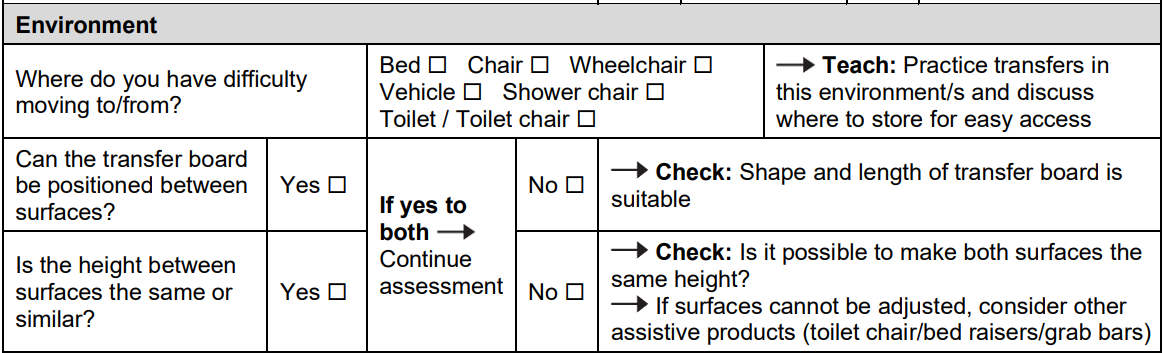
Ask: Where do you have difficulty moving to/from?
A person may need to transfer to and from their wheelchair several times a day in different environments.
Find out where they will be transferring to and from so you can teach the person and/or their caregiver how to use the transfer board in each of these environments.
Question
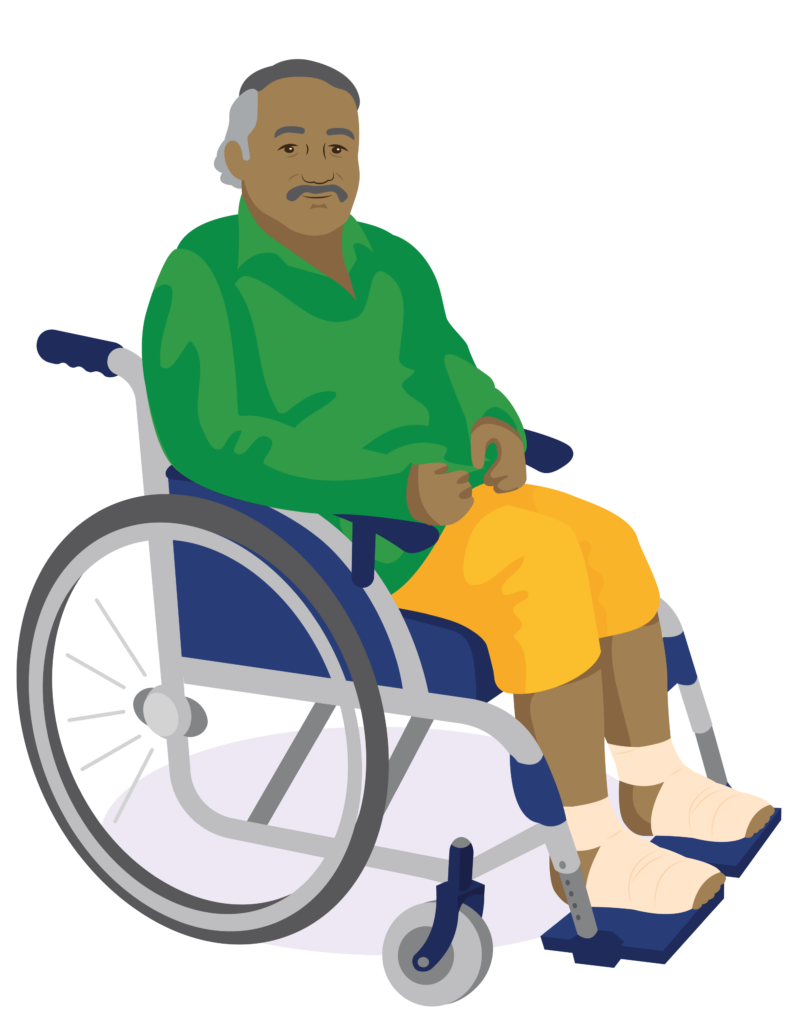
Remember Malu?
Read the completed section of Malu’s assessment form.

Which of the following environments should Malu be taught to use a transfer board in?
Select all that apply.
If you selected a, b, c, and e, you are correct!
Malu will be transferring in each of these environments.
Discuss where to store the transfer board for easy access. For example, by the bed or in a vehicle.
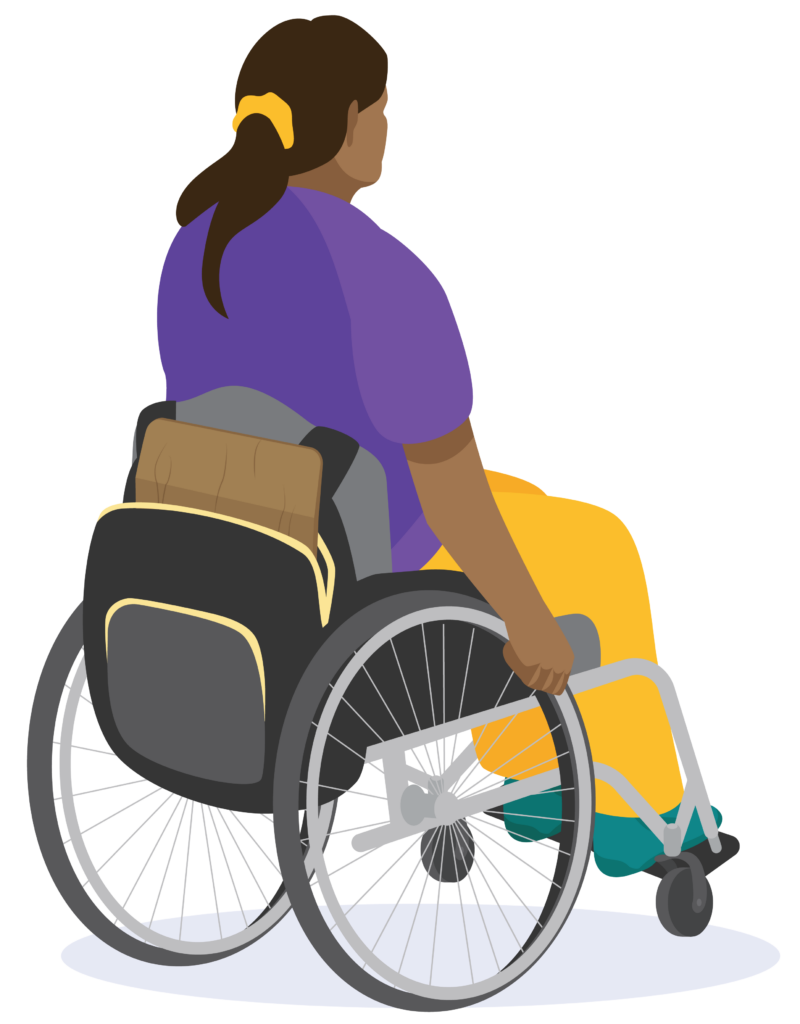
A transfer board can also be carried in a bag for when it is needed outside of the home environment.
Ask:
- Can the transfer board be positioned between surfaces?
- Is the height between surfaces the same or similar?
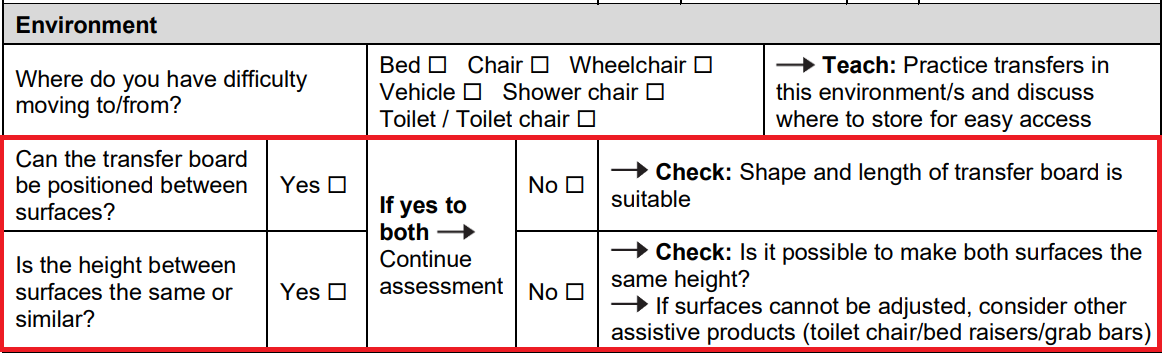
A height difference between surfaces will make it more difficult for a person to transfer.
It is more difficult to balance and lift on a slope.
Together with the person, discuss whether it is possible to adjust the environment to make the surfaces the same or similar height.
Question

Remember Malu?
Malu is 55 years old and has diabetes.
He has been advised to avoid taking weight through his legs while his foot wounds heal and is temporarily using a wheelchair to move around.
Malu is having difficulty in transferring to and from his wheelchair. The bed is higher than the seat of his wheelchair.
1. What difficulty is Malu having with his transfer environment?
If you selected b, you are correct!
The transfer environment is making the transfer harder for Malu because the surfaces are not at the same or similar height.
2. The bed is higher than the wheelchair. What could you suggest to make them both the same or similar height?
Select all that apply.
If you selected b, you are correct!
With Malu’s permission cutting down the bed legs could make the bed and wheelchair the same or similar height.
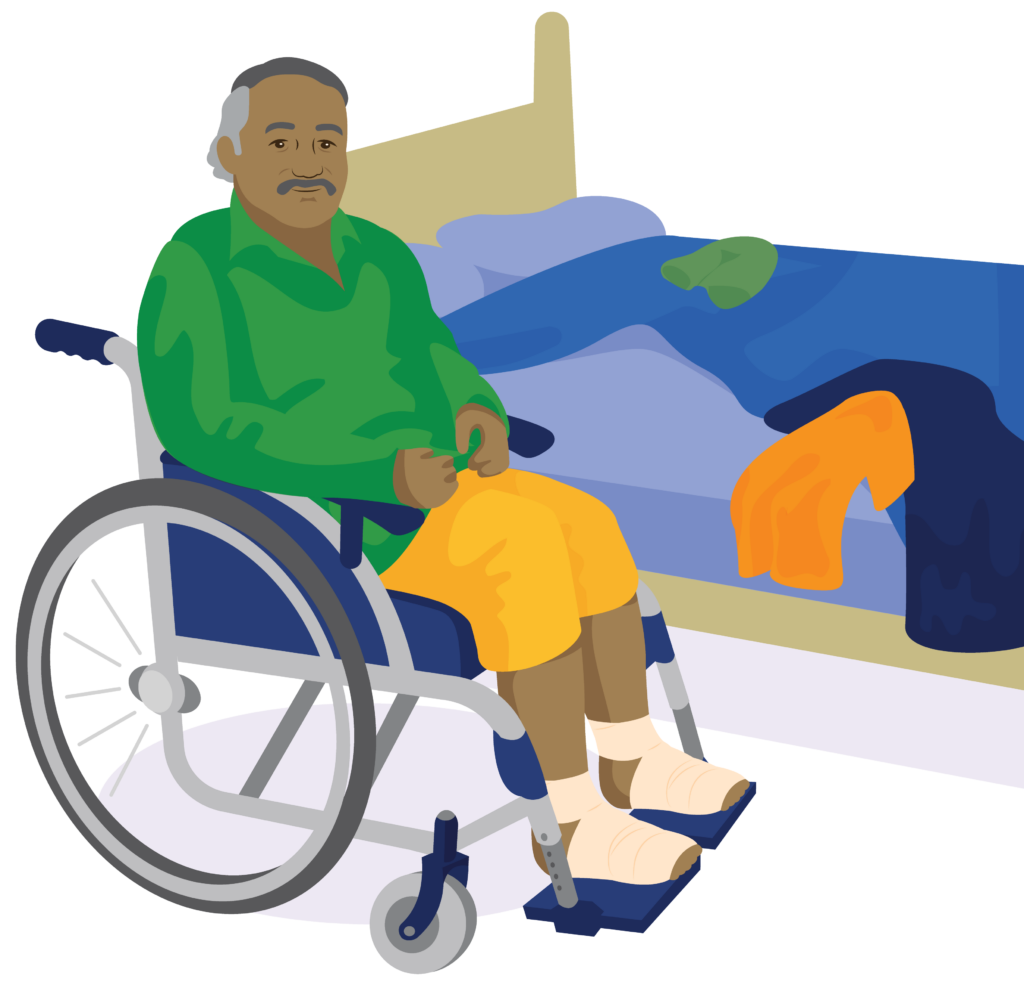
a, c and d are incorrect.
Adding blocks under the bed legs would increase the height difference.
Raising the seat cushion would make Malu sit higher and change his height for all transfers.
Lowering the footrests will not change the height difference between the two surfaces.
Some people will need to use the transfer board over surfaces that cannot be easily adjusted, such as toilet seats or baths.
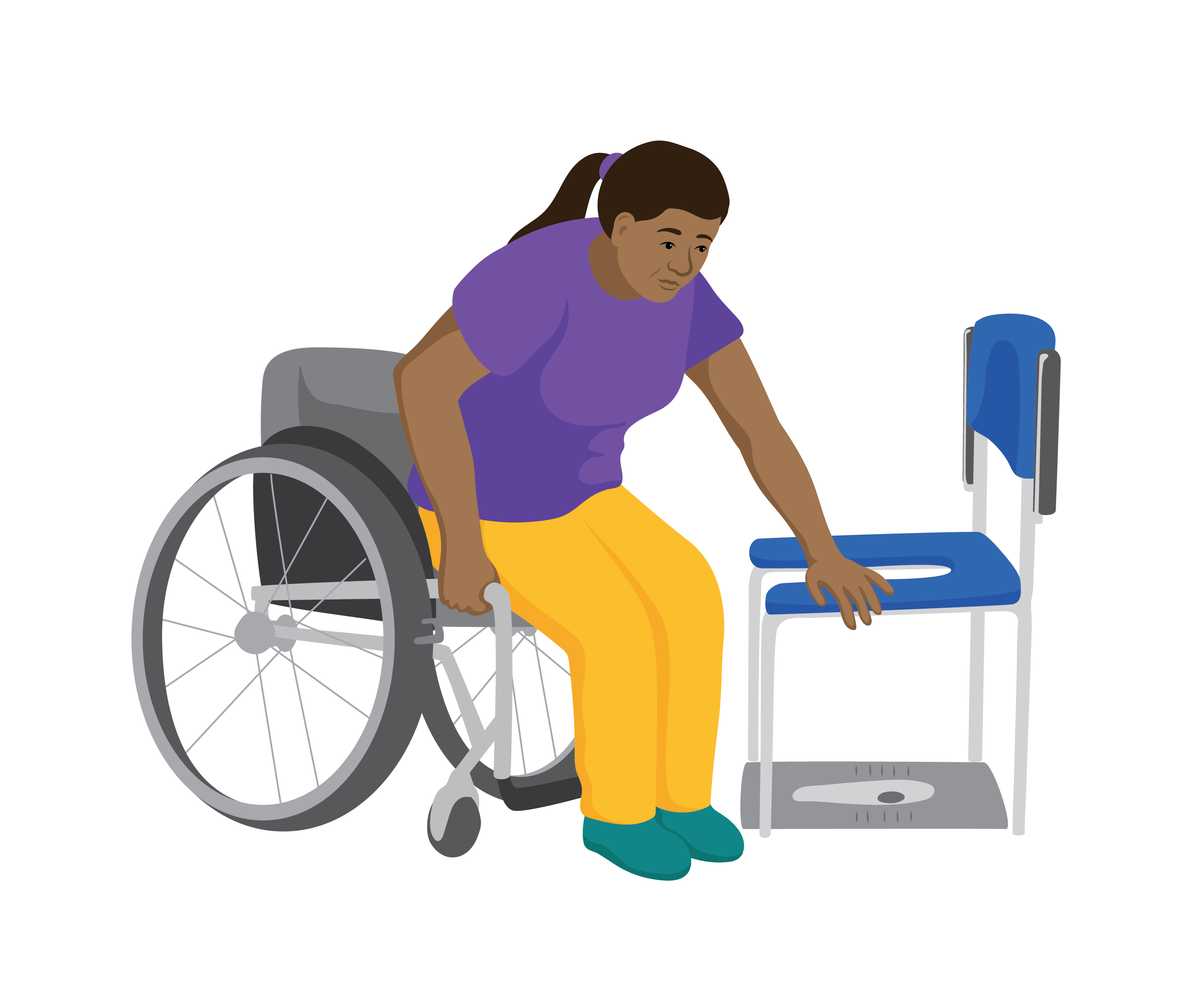
If the height difference is too great to use a transfer board, assess the person for other assistive products or discuss referral to a rehabilitation service.
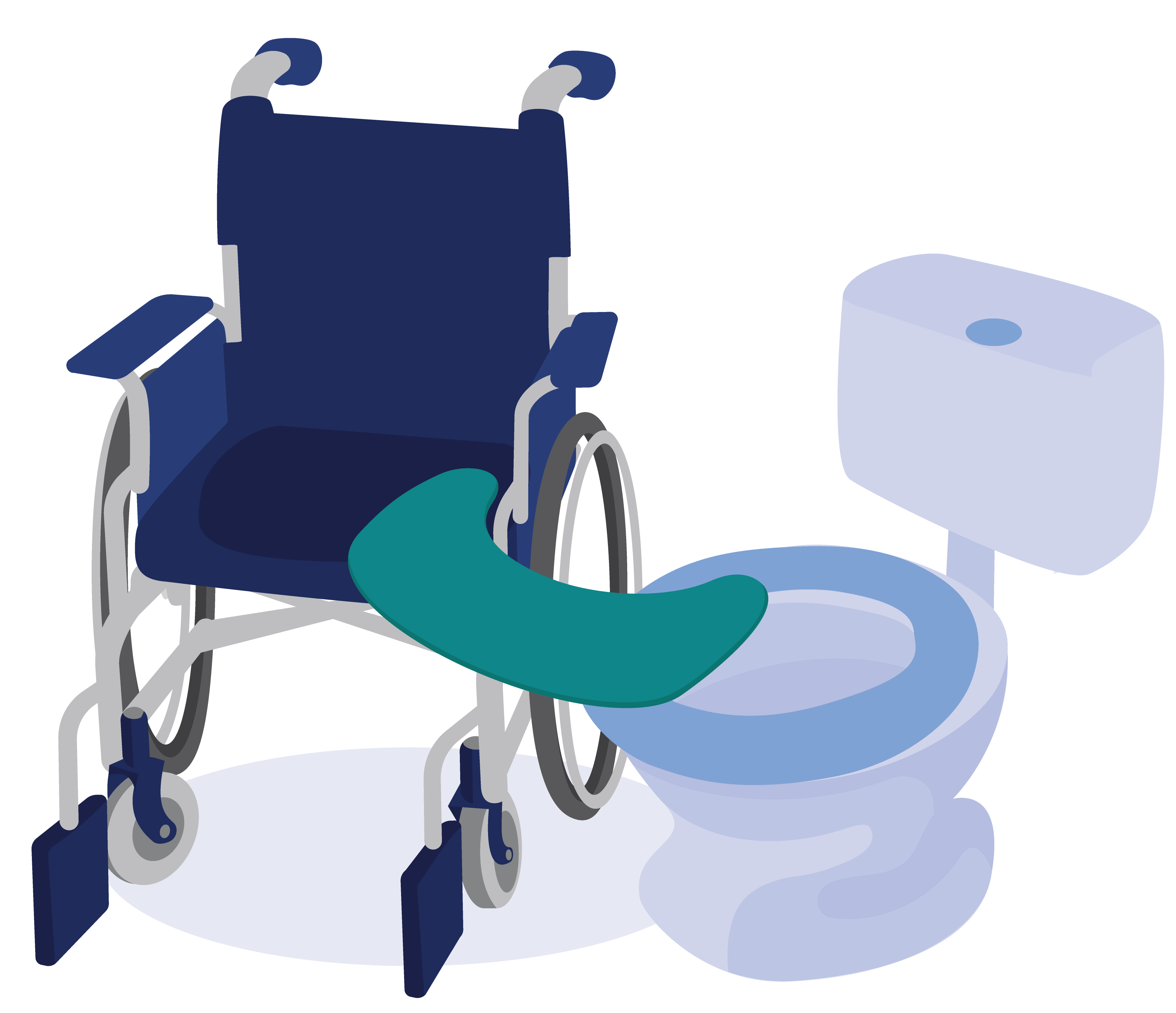
If the space to transfer is limited, try a different shape or shorter transfer board. A curved transfer board may make it easier to position the wheelchair and transfer board in a suitable position.
Additional information
Ask:
- Does your wheelchair and/or toilet chair and/or shower chair have a removable armrest?
- Are your wheelchair brake handles below the top of the wheelchair cushion?

The design of the wheelchair, toilet chair or shower chair can affect selection of the transfer board.
Question
Which transfer board may be easier to position around a fixed armrest?
Curved is correct!
A curved transfer board may be easier to position around obstacles.
Discussion
What types of armrest and brake handles do you commonly see on wheelchairs in your area?
What transfer board may be most suitable for these types of wheelchairs?
Share with each other if you are in a group.