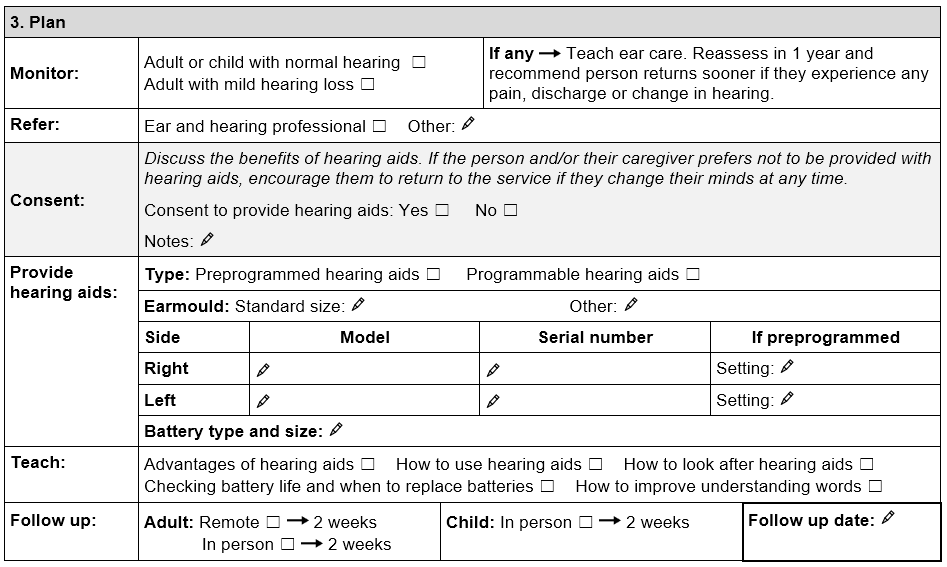
Tras la entrevista de evaluación, elabore un plan junto con el niño y la persona a cargo de sus cuidados. El plan podría incluir:
- Hacer un seguimiento de la capacidad auditiva.
- Hacer una derivación o referencia.
- Proveerle aparatos auditivos.
- Enseñarle al niño y a la persona a cargo de sus cuidados a utilizar los aparatos auditivos de forma segura.
- Programar una cita de seguimiento.
Seguimiento de la capacidad auditiva
Debe hacer un seguimiento de aquellas personas que se encuentren dentro del intervalo auditivo normal y programar una revisión al cabo de un año para evaluar su audición de nuevo.
Anime al niño y a la persona a cargo de los cuidado a que vuelvan antes si se produce algún cambio en la audición.
¿Recuerda a Anju?

El resultado de la prueba de la capacidad auditiva de Anju se situó dentro de los límites normales de audición en ambos oídos.
El trabajador de salud explica que hay algunas medidas sencillas que ayudarán a mantener los oídos sanos de Anju, como por ejemplo:
- Avoid putting anything inside ears
- Evite nadar en aguas que no estén limpias.
- Utilice tapones para los oídos en entornos ruidosos.
El trabajador de salud le pide a Anju y a sus padres que vuelvan dentro de un año para repetir la prueba de la capacidad auditiva y controlar la audición de Anju. Además, les indica que vuelvan antes, si Anju tiene dolor de oído, secreciones o algún cambio en la audición.
Derivación.
Algunos niños necesitan una evaluación más especializada por parte de un especialista del oído y la audición.
No se deben proveer aparatos auditivos en los siguientes casos:
- tienen una pérdida de la capacidad auditiva de grave a profunda;
- tienen una pérdida auditiva asimétrica, es decir, una diferencia mayor a 15 dB entre el oído derecho y el izquierdo.
Con permiso de la persona a cargo de los cuidados, haga la derivación a un especialista del oído y la audición.
Si no tiene confianza en el resultado de la prueba, háblalo con el facilitador y proceda con la derivación a un especialista del oído y la audición.
Pregunta
Lea los siguientes casos prácticos.
1. Beth tiene 13 años. El umbral auditivo medio de su oído derecho es de 67 dB, mientras que el umbral auditivo medio de su oído izquierdo es de 69 dB.
Consulte la tabla con los grados de pérdida auditiva.
| Grado | Promedio | Recomendación |
| Dentro de los parámetros normales | Promedio inferior a 20 dB | Adultos y niños: no necesitan aparatos auditivos. Enséñeles a cuidar sus oídos y evalúe de nuevo al cabo de un año o antes, si la persona o una persona a cargo de los cuidados de otra notan algún cambio en la audición o en la salud de los oídos. |
| Pérdida auditiva leve. | Promedio entre 20 y 34 dB | Niños: colocación de un aparato auditivo. Adultos: hacer un seguimiento y volver a evaluar al cabo de un año. Educación sobre cómo cuidar los oídos. |
| Pérdida auditiva moderada. | Promedio entre 35 y 49 dB | Adultos y niños: colocación de aparatos auditivos. |
| Pérdida auditiva moderadamente grave. | Promedio entre 50 y 64 dB | Adultos y niños: colocación de aparatos auditivos. |
| Pérdida auditiva grave. | Promedio entre 65 y 79 dB | Niños: derivar a un especialista de oído y la audición. Adultos: colocación de aparatos auditivos. |
| Pérdida auditiva profunda. | Promedio superior a 80 dB | Adultos y niños: derivación a especialistas del oído y la audición. |
¿Cuál sería el próximo paso?
Seleccione una respuesta.
¡Hacer la derivación es lo correcto!
Beth tiene una pérdida auditiva grave. Con el permiso de la persona a cargo de sus cuidados, derívela a un especialista del oído y la audición para que se le haga una evaluación más especializada.
2. Jampa tiene 11 años. El umbral auditivo promedio de su oído derecho es de 23 dB, mientras que el de su oído izquierdo es de 55 dB.
¿Cuál sería el próximo paso?
Seleccione una respuesta.
¡Hacer la derivación es lo correcto!
Jampa tiene una diferencia mayor a 15 dB entre el oído derecho y el izquierdo. Con el permiso de la persona a cargo de sus cuidados, derívelo a un especialista del oído y la audición para que se le haga una evaluación más especializada.
Consentimiento
Algunos niños y niñas se beneficiarán del uso de aparatos auditivos.
Explique las posibles ventajas de los aparatos auditivos y ofrézcale la chance de probarlos antes de tomar una decisión.
Si el niño o la persona a cargo de los cuidados no quieren usar aparatos auditivos, anímeles a que vuelvan al servicio en cualquier momento, si cambian de opinión.
Anote si el niño o la persona a cargo de los cuidados dan su consentimiento para la provisión de aparatos auditivos.
Proveerle de aparatos auditivos.
En primer lugar, seleccione el tipo de aparato auditivo programable entre las opciones disponibles.
Anote los datos en el formulario e incluya:
- Aparatos auditivos.
- Molde auditivo
- Pila.
Consejos
Compruebe el embalaje y el manual para el usuario para ver los números de serie. Es posible que, al conectar el aparato auditivo programable, su número de serie quede registrado en el software de programación.
Enseñar cómo usar los aparatos auditivos
Para sacarle el máximo partido a los aparatos auditivos, es importante que tanto el niño como la persona a cargo de sus cuidados, comprendan lo siguiente:
- Las ventajas de los aparatos auditivos.
- Cómo utilizar y cuidar los aparatos auditivos.
- Cómo determinar la duración de la pila y cuándo hay que cambiarla.
- Cómo mejorar la comprensión de las palabras.
Instrucciones
En la lección cuatro encontrará más información sobre cómo utilizar los aparatos auditivos.
Seguimiento
Los niños necesitan tiempo para acostumbrarse a usar los aparatos auditivos. Darles consejos para resolver problemas sencillos puede ser de gran utilidad.
Es importante hacer un seguimiento en persona con el niño y la persona a cargo de los cuidados en un plazo de dos semanas para comprobar cómo se siente.
Instrucciones
Obtenga más información en la lección cinco sobre el seguimiento de los aparatos auditivos.
Instrucciones
Elabore un plan para Basir y ponga a prueba sus conocimientos.
Pregunta

¿Recuerda a Basir?
Basir tiene seis años y acude a la escuela con su hermana Siti, de cinco años. Tras una prueba de detección realizada en la escuela, se derivó a Basir para hacer una prueba de la capacidad auditiva, tras la cual se lo diagnosticó una pérdida auditiva. Los resultados muestran que Basir tiene un umbral auditivo promedio de 53,75 dB en el oído derecho y de 56,25 dB en el izquierdo.
Consulte la tabla con los grados de pérdida auditiva.
| Grado | Promedio | Recomendación |
| Dentro de los parámetros normales | Promedio inferior a 20 dB | Adultos y niños: no necesitan aparatos auditivos. Enséñeles a cuidar sus oídos y evalúe de nuevo al cabo de un año o antes, si la persona o una persona a cargo de los cuidados de otra notan algún cambio en la audición o en la salud de los oídos. |
| Pérdida auditiva leve. | Promedio entre 20 y 34 dB | Niños: colocación de un aparato auditivo. Adultos: hacer un seguimiento y volver a evaluar al cabo de un año. Educación sobre cómo cuidar los oídos. |
| Pérdida auditiva moderada. | Promedio entre 35 y 49 dB | Adultos y niños: colocación de aparatos auditivos. |
| Pérdida auditiva moderadamente grave. | Promedio entre 50 y 64 dB | Adultos y niños: colocación de aparatos auditivos. |
| Pérdida auditiva grave. | Promedio entre 65 y 79 dB | Niños: derivar a un especialista de oído y la audición. Adultos: colocación de aparatos auditivos. |
| Pérdida auditiva profunda. | Promedio superior a 80 dB | Adultos y niños: derive a un especialista del oído y la audición. |
¿Qué medida recomendaría para Basir?
Seleccione una respuesta.
¡Proveerle aparatos auditivos es correcto!
Basir tiene una pérdida moderadamente grave de la capacidad auditiva en ambos oídos, por lo que se le recomienda proceder con el ajuste del aparato auditivo.