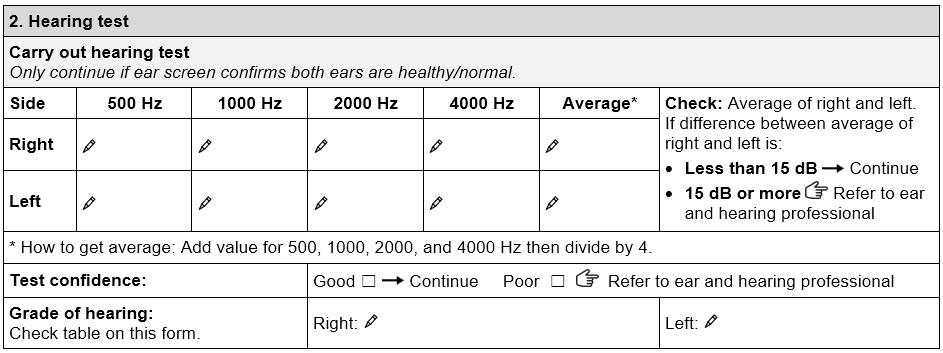
Haga la prueba de la capacidad auditiva en los oídos derecho e izquierdo para detectar una posible pérdida auditiva. Los resultados serán de ayuda para que decidan entre todos si los aparatos auditivo podrían ser de ayuda.
Instrucciones
Consulte la sección sobre la prueba de la capacidad auditiva en el formulario de evaluación y compruebe el cuadro de los grados de pérdida auditiva para averiguar si el niño tiene alguna pérdida auditiva.
Pregunta
¿Qué puede hacer para que a un niño con pérdida auditiva le resulte más fácil entender lo que dice?
Seleccione dos respuestas.
Si ha seleccionado las respuestas c y d, ¡está en lo correcto!
Siéntese a la misma altura que el niño, asegúrese de que su cara esté bien iluminada y hable despacio y con nitidez, para que sea más fácil entenderle.
Enfoque centrado en el niño
Prepare a la persona la prueba de la capacidad auditiva de una forma sencilla, divertida y lúdica.
Muéstrele el equipo para que sepan qué va a pasar durante el prueba de la capacidad auditiva.
Instrucciones
Mire este video en el que un miembro del personal de salud utiliza un enfoque adaptado a los niños para explicar la prueba de la capacidad auditiva.
Pregunta
Mire esta foto de un trabajador de salud mientras muestra el material mediante un enfoque adaptado a los niños.

1. ¿Qué hace que este enfoque sea adecuado para los niños?
- Sentarse a la altura del niño.
- Sonreír y mirar al niño.
- Dejar que el niño vea el material.
2. ¿De qué otras formas se los puede tranquilizar a un niño durante un prueba de la capacidad auditiva?
Otras formas de tranquilizar a un niño son, entre otras:
- Con un tono amable.
- Explicar las cosas con calma y comprobar que haya entendido bien.
- Reafirmarle que lo está haciendo bien.
Cómo hacer la prueba de la capacidad auditiva
Al proceder con la prueba de la capacidad:
- Explique en qué consiste la prueba.
- Haga una prueba preliminar, a manera de práctica.
- Haga la prueba de la capacidad auditiva.
- Calcular el umbral auditivo promedio.
- Anote los resultados de cada oído.
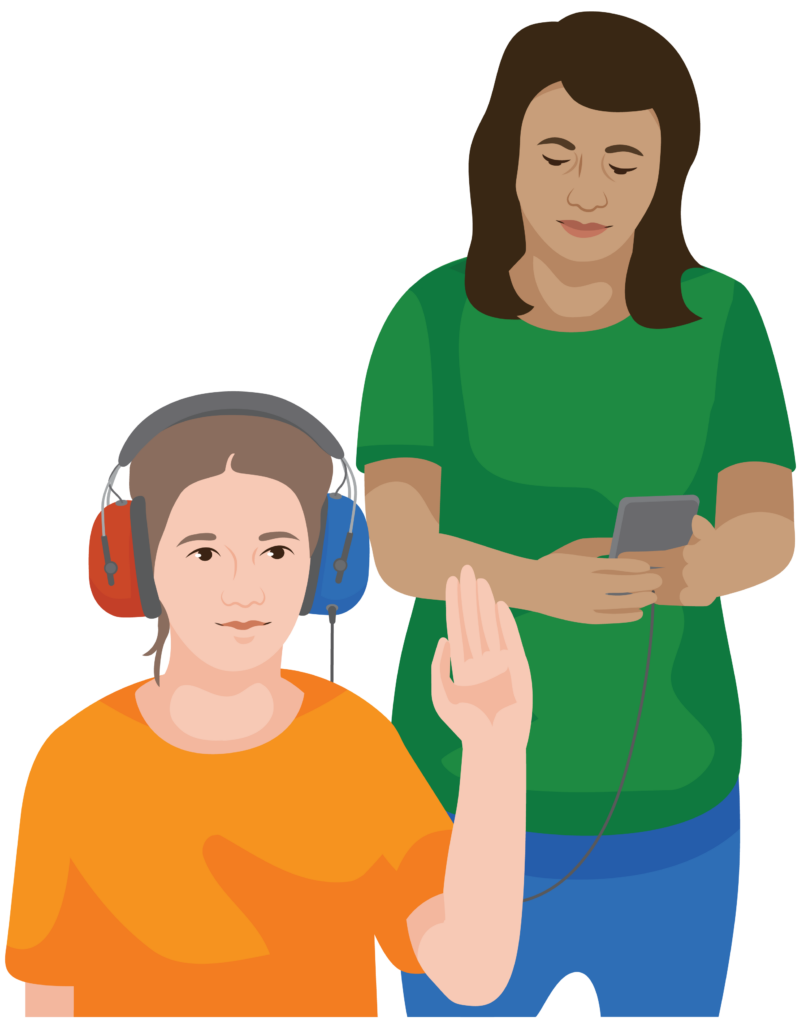
1. Explique en qué consiste la prueba
Explíquele que va a evaluar su capacidad auditiva midiendo el sonido más bajo que es capaz de oír (umbral auditivo).
2. Haga un examen preliminar, a manera de práctica
Siéntese de frente para que pueda verle bien.
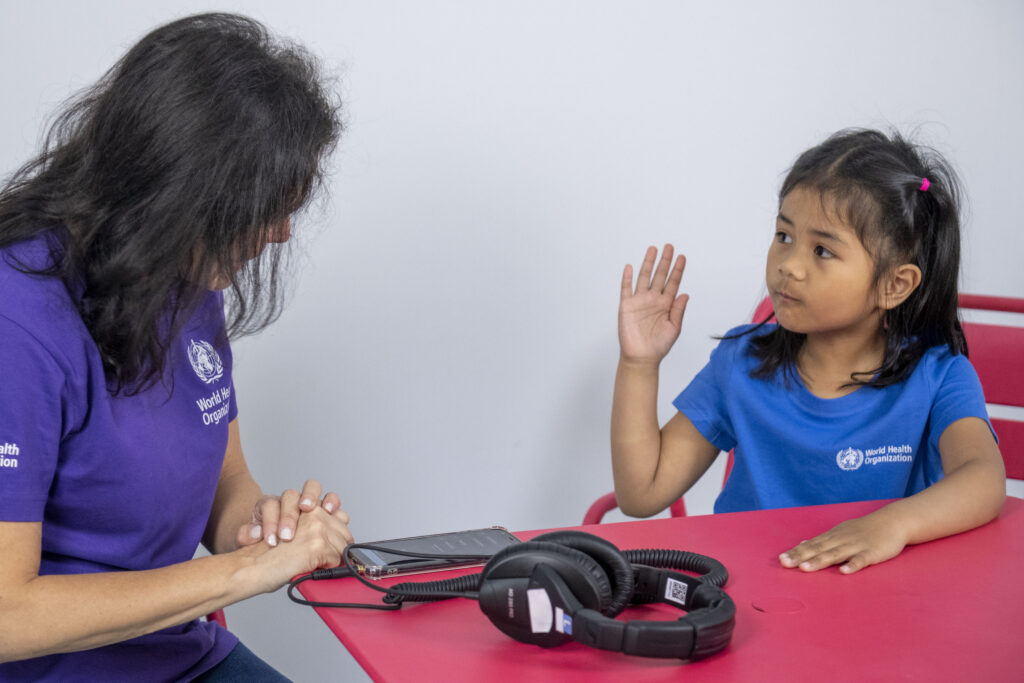
Explíquele a la persona que:
- apenas oiga el sonido, debe pulsar el botón de respuesta o levantar la mano del mismo lado que lo oye;
- suelte el botón o baje la mano apenas deje de oír el sonido;
- antes de ponerte los auriculares, practica la respuesta de la prueba;
- cuando responda, dígale algún cumplido y dele animo.
Consejos
Si no responde a la prueba, puede resultar útil:
- usar juguetes o pegatinas para animarle a participar;
- cambiar la señal de respuesta; por ejemplo, que agite la mano o deje caer un juguete cuando oiga el sonido;
- haga una demostración con la persona a cargo de sus cuidados;
- muéstrales un vídeo de otro niño realizando la tarea.
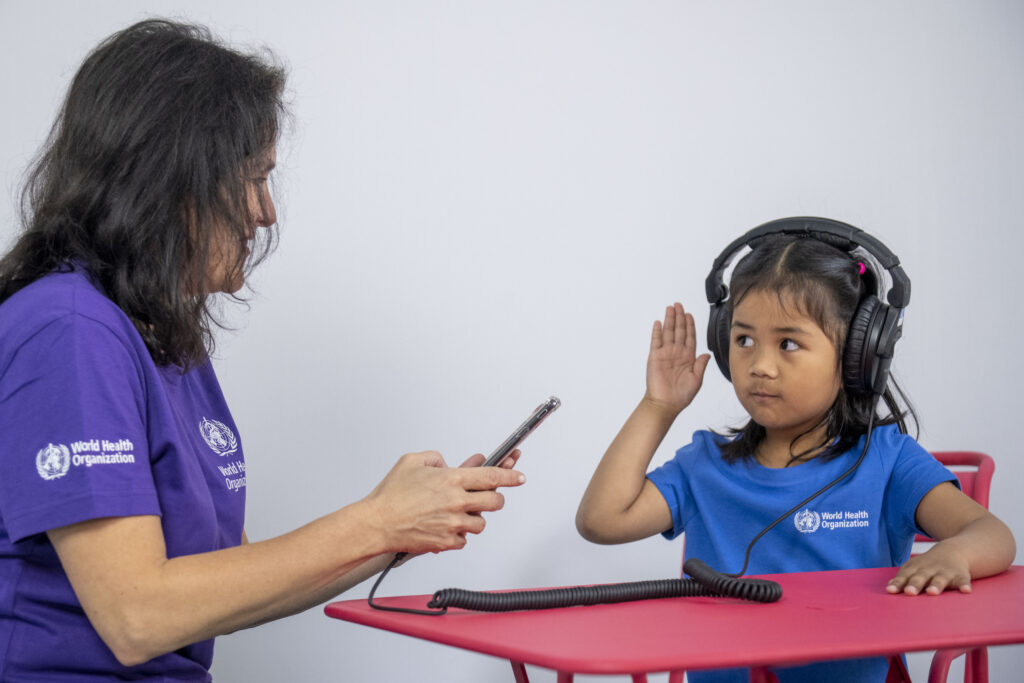
Practique primero a 1000 Hertz (Hz) y 40 decibelios (dB):
- pídale que se ponga los audífonos con cancelación de ruido;
- compruebe que los audífonos estén bien colocados;
- haga el ejercicio dos veces en cada oído.
Consejos
Si el niño no oye el sonido de prueba, aumente el volumen en 10 dB y repita la prueba.
3. Haga la prueba de la capacidad auditiva
- colóquele los audífonos con cancelación de ruido;
- compruebe que los audífonos estén bien colocados;
- empiece la prueba por el oído con el que el niño oye mejor; si no se sabe cuál es, empiece por el oído derecho;
- ajuste el selector de frecuencia a 1000 Hz y la intensidad a 40 dB.
Consejos
Para obtener resultados más precisos:
- ubíquese de forma que no lo puedan cer mientras emite el sonido;
- cambie el ritmo en que emite los sonidos. El objetivo es evitar que adivinen cuándo emitirá el siguiente.
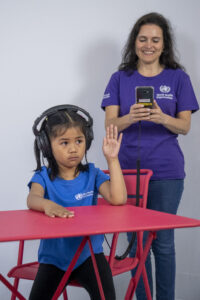
Higher frequency sounds of 1000 Hz are usually easier to hear and give a child confidence at the start of a hearing test.
- Press the button for 2 to 3 seconds and see if the child raises their hand:
- If the child raises their hand, reduce the intensity level by 10 dB
- If the child does not respond, increase the intensity level by 5 dB
- Continue until you find the quietest sound the child can hear:
- Repita el sonido tres veces para confirmar el umbral auditivo.
- If the child responds correctly at least two out of three times at the frequency tested, record threshold on form
- Repita la prueba a 2000 Hz, 4000 Hz y 500 Hz.
- Repeat on the child’s left ear.
Instrucciones
Watch this video of a child having a hearing test.
Actividad
En grupos, practiquen cómo realizar la prueba de la capacidad auditiva con un niño o niña que no tenga pérdida auditiva.
Preparación:
- elija un espacio;
- compruebe que el nivel de sonido sea adecuado con un sonómetro o una aplicación que haya descargado. hearWHO:
- Haga clic en “Examine su audición” para acceder al sonómetro.
- Allow permission to measure noise.
Prueba:
- explíquele la prueba de una forma fácil de entender para los niños;
- realice la prueba a 1000, 2000, 4000 y 500 Hz en el oído con mejor audición o en el oído derecho;
- anote el sonido más débil que el niño oiga para cada frecuencia;
- repita el procedimiento con el otro oído.
Grado de confianza en los resultados de la prueba
Al realizar la prueba de la capacidad auditiva, tenga en cuenta el grado de confianza que tiene en los resultados.
Puede tener confianza si el niño:
- responde de forma congruente a los sonidos de la prueba;
- se determina el umbral auditivo para cada frecuencia.
Puede tener poca o ninguna confianza si el niño:
- responde de forma aleatoria a los sonidos de la prueba;
- reacciona incluso cuando no se emite ningún sonido;
- solo reacciona cuando ve que la persona a cargo de emitir los sonidos hace algún movimiento.
Si tiene confianza en el resultado de la prueba, continúe.
Si, tras hablar con el facilitador, tiene poca confianza en el resultado, derive a la persona a un profesional del oído y la audición.
Advertencia
Los resultados de las pruebas deben ser precisos para programar correctamente los aparatos auditivos.
4. Calcular el promedio del umbral auditivo
- Calcule el valor promedio en dB sumando los valores del umbral auditivo de 500 Hz, 1000 Hz, 2000 Hz y 4000 Hz, y dividiendo el resultado entre cuatro.
- Compare el promedio de los umbrales del oído derecho y del izquierdo:
- Menos de 15 dB de diferencia, continúe.
- Una diferencia de 15 dB o más, derive a un especialista del oído y la audición.
En el caso de niños con pérdida auditiva unilateral (pérdida auditiva en un solo oído) y asimétrica (diferencia de más de 15 dB entre los umbrales promedio del oído derecho y del izquierdo), sus necesidades son más complejas. En ese caso, derive a un especialista del oído y la audición.
Instrucciones
Responda a las siguientes preguntas para poner a prueba sus conocimientos sobre el módulo de Aparatos auditivos preprogramados del TAP.
Pregunta

Ella es Anju
Anju tiene seis años y va a la escuela.
Anju ha recibido tratamiento para una infección de oído y vuelve con sus padres al centro de salud local hacese una revisión de la salud auditiva y una prueba de la capacidad auditiva.
El profesional de salud hace una revisión de la salud auditiva. Sus dos oídos están sanos. A continuación, proceden con la prueba de la capacidad auditiva, donde Anju responde con seguridad.
Fíjese en los umbrales auditivos para cada frecuencia.
| Lado | 500 Hz | 1000 Hz | 2000 Hz | 4000 Hz |
| Derecho | 15 | 10 | 20 | 10 |
| Izquierdo | 10 | 10 | 15 | 15 |
1. ¿Cuál es el umbral auditivo promedio correcto del oído derecho de Anju?
¡El valor de 13,75 dB es correcto!
Es el promedio que se obtiene al sumar todos los números y dividir el resultado entre cuatro.
2. ¿Cuál es el umbral auditivo promedio correcto para el oído izquierdo de Anju?
¡El valor de 12,50 dB es correcto!
Es el promedio que se obtiene al sumar todos los números y dividir el resultado entre cuatro.
3. ¿Anju tiene una diferencia inferior a 15 dB entre el oído derecho y el izquierdo?
Seleccione una respuesta.
“Sí” es la respuesta correcta.
La diferencia es inferior a 15 dB. Puedes continuar.
Consulte el cuadro de grados de pérdida auditiva en formulario de evaluación o a continuación.
| Grado | Promedio |
| Dentro de los parámetros normales | Promedio inferior a 20 dB |
| Pérdida auditiva leve. | Promedio entre 20 y 34 dB |
| Pérdida auditiva moderada. | Promedio entre 35 y 49 dB |
| Pérdida auditiva moderadamente grave. | Promedio entre 50 y 64 dB |
| Pérdida auditiva grave. | Promedio entre 65 y 79 dB |
| Pérdida auditiva profunda. | Promedio superior a 80 dB |
4. ¿Cuál es el grado de pérdida auditiva del oído derecho de Anju?
Seleccione una respuesta.
¡Intervalo auditivo normal es el correcto!
El valor de 13,75 dB está dentro del intervalo auditivo normal.
5. What is the grade of hearing loss for Anju’s left ear?
Seleccione una respuesta.
¡Intervalo auditivo normal es el correcto!
El valor de 12,50 dB está dentro del intervalo auditivo normal.
5. Anote el resultado correspondiente a cada oído
- Anote los valores promedios de la capacidad auditiva obtenidos en la sección del formulario correspondiente a la prueba.
- Anote el nivel de confianza de la prueba.
- Anote el grado de capacidad auditiva del oído derecho y del izquierdo.
Siga las medidas recomendadas correspondientes al nivel de pérdida auditiva de la persona (consulte la tabla "Grado de pérdida auditiva").
Explique los resultados de la prueba
Una vez completada la prueba de la pérdida auditiva y de determinado el grado de pérdida auditiva, explique los resultados e indique si el niño o la niña podría beneficiarse del uso de aparatos auditivos.
¿Recuerda a Anju?
Explíquele a Anju y a sus padres que los resultados de la prueba de la capacidad auditiva de Anju indican que su audición es normal y no necesita aparatos auditivos.