The TAP Wheelchairs in emergencies assessment form is a simple version of the assessment used in a non-emergency context. It includes information for use in emergency situations.
The assessment form includes:
- Assessment interview: to aid in selection of a temporary or long term use wheelchair
- Simple health and sitting ability checks: to identify if a person needs a priority follow up plan
- Fit: including preparation of the selected wheelchair and fitting check
- Plan: of what to teach, whether the person needs referral, and their follow up needs.
Set up location
If possible, wheelchairs in emergencies will be provided within existing emergency medical, surgical or rehabilitation services and close to other health services.
It is important to have access to:
- An accessible toilet or toilet chair located in a private area
- Screened area for checking a person’s skin for pressure wounds.

Existing health service

Temporary set up near health service
Speed of service provision
To help speed up service, consider:
- Having different people or teams working on:
- Assessment / fitting
- Teaching how to use
- Including experienced wheelchair users to lead or support teaching skills
- Teaching skills to groups of wheelchair users where possible
- Identifying a space which has rough ground, slope and steps for wheelchair skills training
- Have the training space close to the assessment and fitting area.
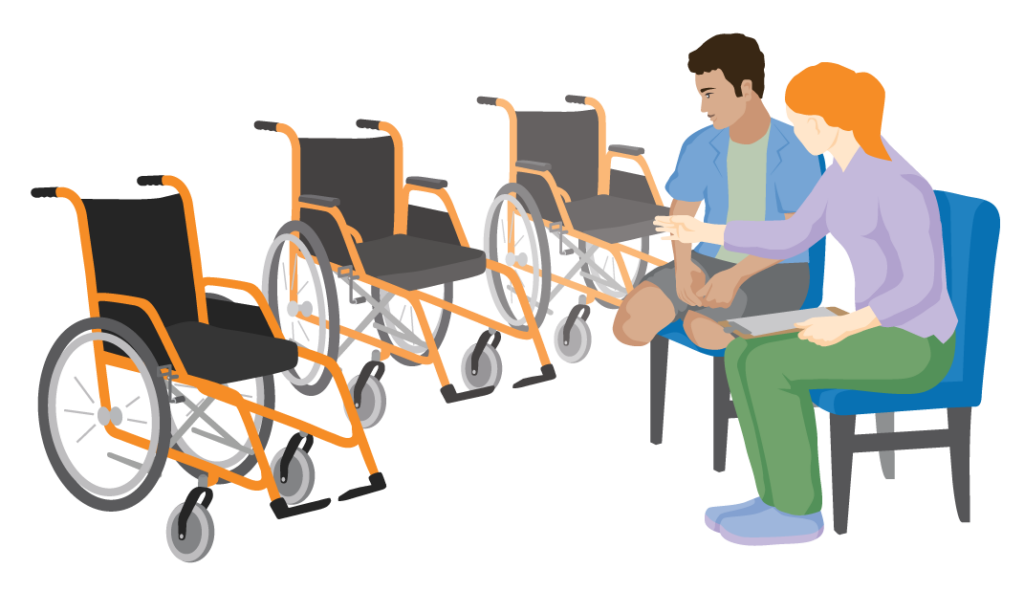
Wheelchairs assembled in each size
Assemble one of each type of wheelchair in each available size. This will speed up selection of the correct size.
Taking measurements and ordering wheelchairs while the person is waiting is not included in this module.
To find out more about measuring see the WHO Wheelchair Service Training Package.
Question
In an emergency situation it is important to respond quickly to a person’s needs.
Which of the following can help improve the speed of selecting a suitable wheelchair?
Select all that apply.
If you selected a, b and e, you are correct!
To increase the speed of selecting the right type and size of wheelchair for a person’s needs:
- Store wheelchairs near where they are provided
- Store wheelchairs and cushions by type and size
- Keep assembled wheelchairs in each size.
c and d are incorrect.
Having experienced wheelchair users leading or supporting teaching how to use wheelchairs, and using a space close to where wheelchairs are provided cannot speed up selecting a wheelchair.
Instead, they can increase the speed of teaching how to use a wheelchair.