In this topic we will look at the TAP Wheelchairs in emergencies assessment form. If you have not done so already, download and print a copy.
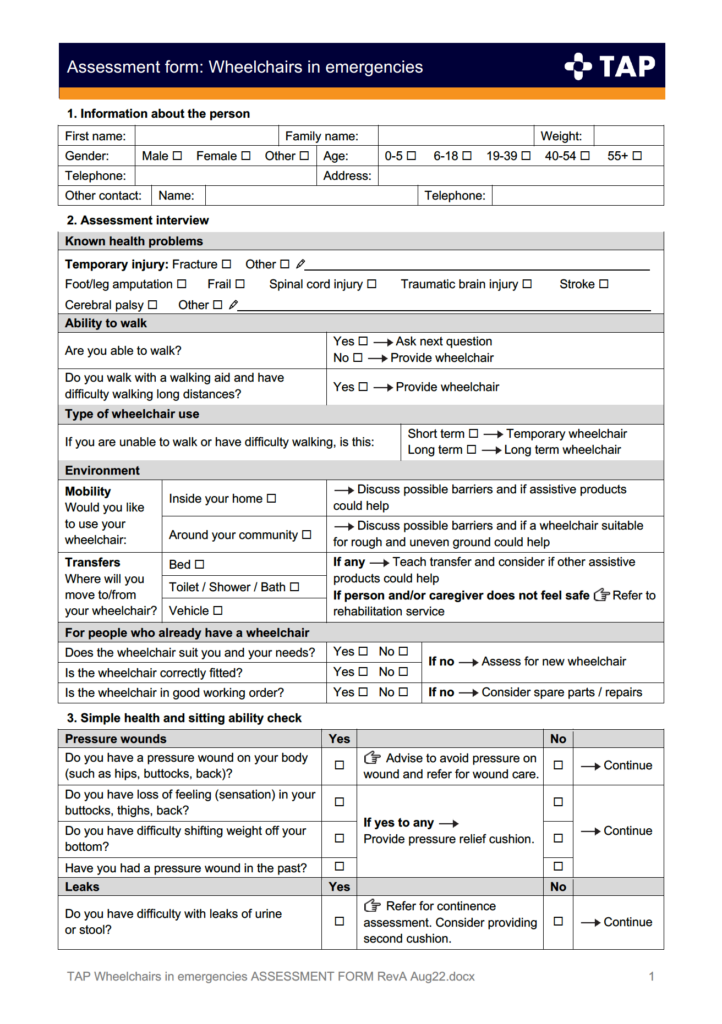
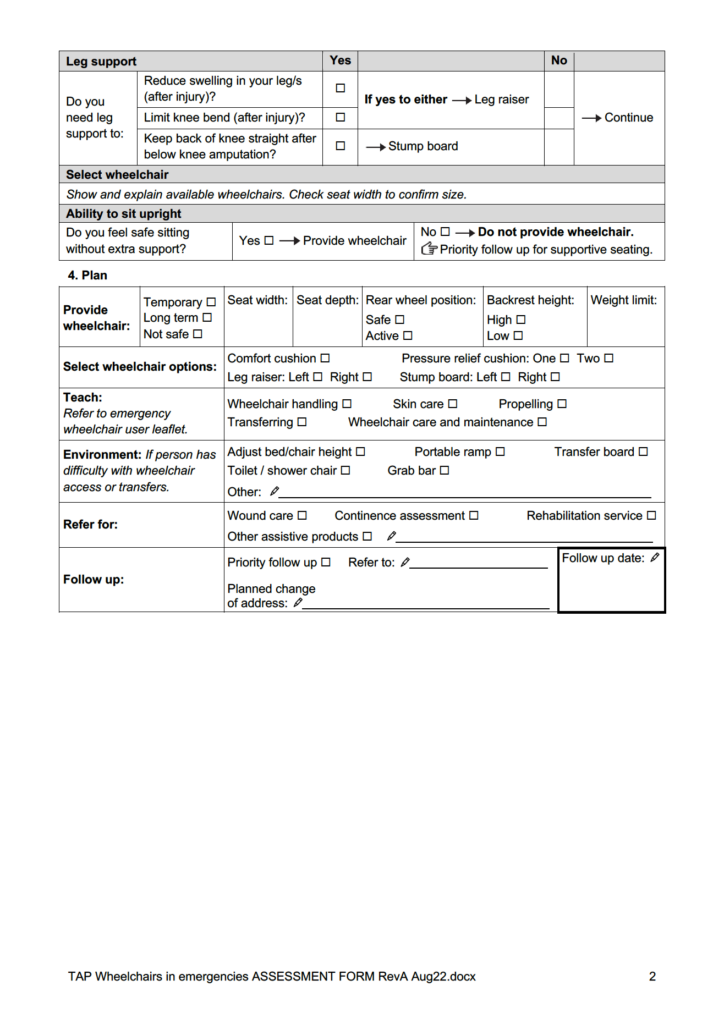
Assessment is an important first step in providing a wheelchair in an emergency.
Information from the assessment will help you to plan:
- Whether the person needs a temporary or long term wheelchair
- What to teach the person
- If they have priority follow up needs
- Referral to other services.
Whenever you see this icon on the form, it means the person may need a referral.
Find a space to sit with the person. Use the questions on the assessment form to learn about:
- Any health problems they have
- Whether they need a wheelchair temporarily or long term
- Whether they have previously used a wheelchair and if it was meeting their needs
- Their sitting ability.
Explain to the person these questions help to select the most suitable wheelchair.
Involve the person and/or the caregiver so you can understand what they need to do with a wheelchair in an emergency.
Information about the person
Start by collecting general information about the person, including their contact details, gender and age.

People may change location in emergencies and a mobile telephone number is essential for follow up. Ask for a second contact number, if the person has one available.
Weight
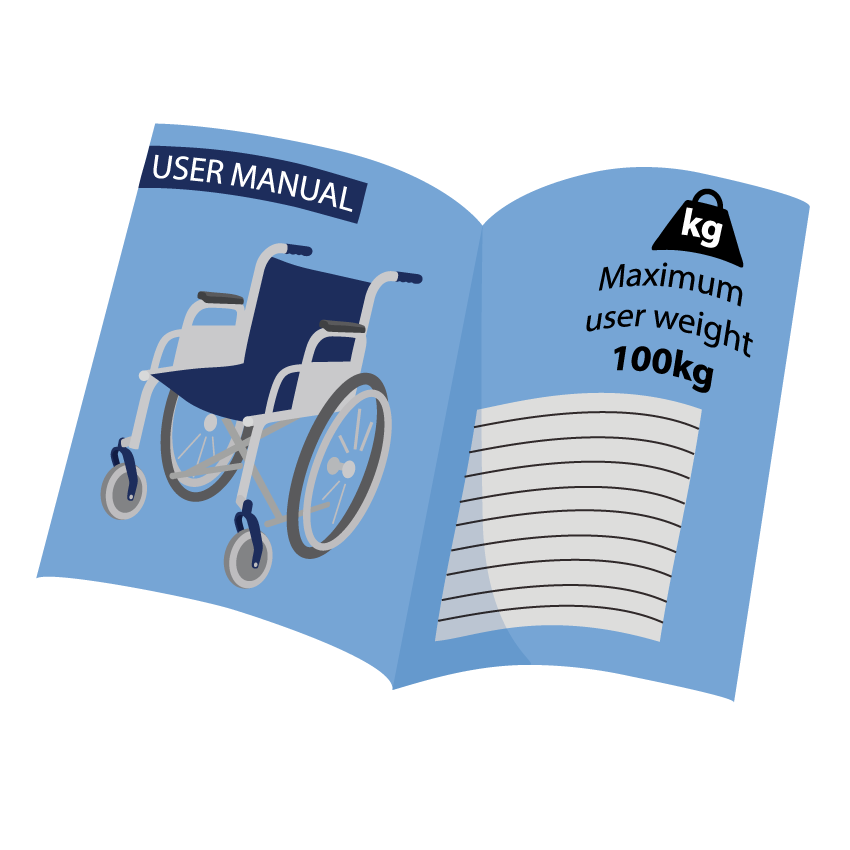
You also need to record the person’s weight. This can be an estimate if they don’t know and you do not have scales.
Question
Why is it important to record the person’s weight?
If you selected b, you are correct!
The person’s weight is important because wheelchairs have a maximum weight limit that they can hold safely.
a and c are incorrect.
Assessment interview
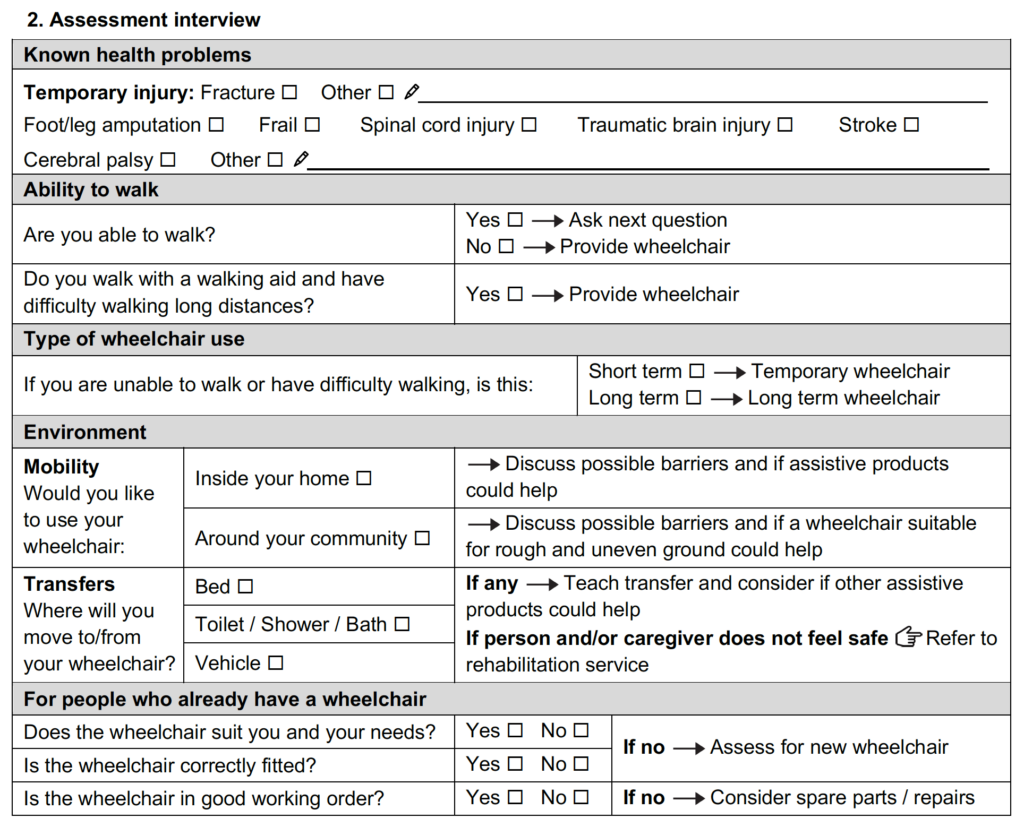
Known health problems
Use this part of the assessment form to find out if the person has any known health problems.
A known health problem can help to guide the choice of wheelchair. However, there are also other factors to consider.
Question
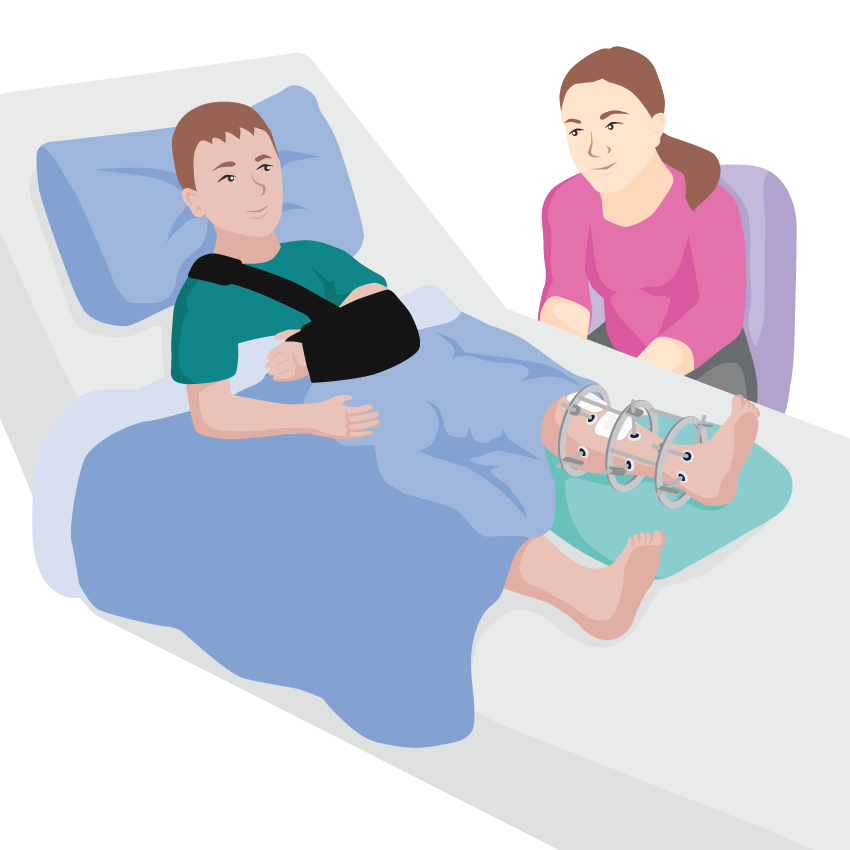
Remember Roman?
Roman is 10 years old and had a severe injury to his leg. He also injured his arm.
He has an external fixator on his leg and cannot put weight through it until his injuries heal.
Which health problem/s would you select for Roman?
Select all that apply.
If you selected a, you are correct!
Roman has a fracture, which is a temporary injury.
You should also write that he has an external fixator to help him heal.

Unknown health problems
A person may have a health problem but not know what it is called.
It is important to find out how the health problem affects the person’s mobility and ability to sit.

Ability to walk
Ask the person:
- Are you able to walk?
- Do you walk with a walking aid but have difficulty walking longer distances?
A person may be:
- Unable to walk and use the wheelchair for all their mobility
- Able to walk with a walking aid but have difficulty walking longer distances:
- Outdoors
- Inside larger buildings.
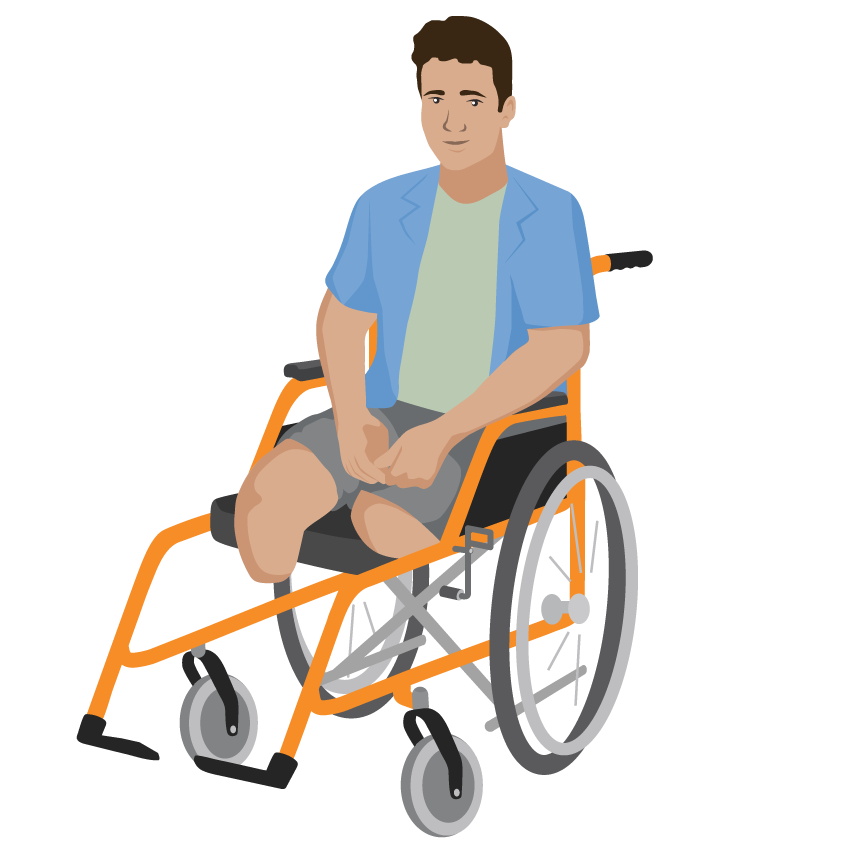
Meet Jalus
Jalus is 23 years old and lives in the mountains. His legs were crushed in a landslide after an earthquake. He had emergency surgery to amputate one leg above his knee and his other leg below the knee.
At the moment Jalus is unable to walk and needs a wheelchair.

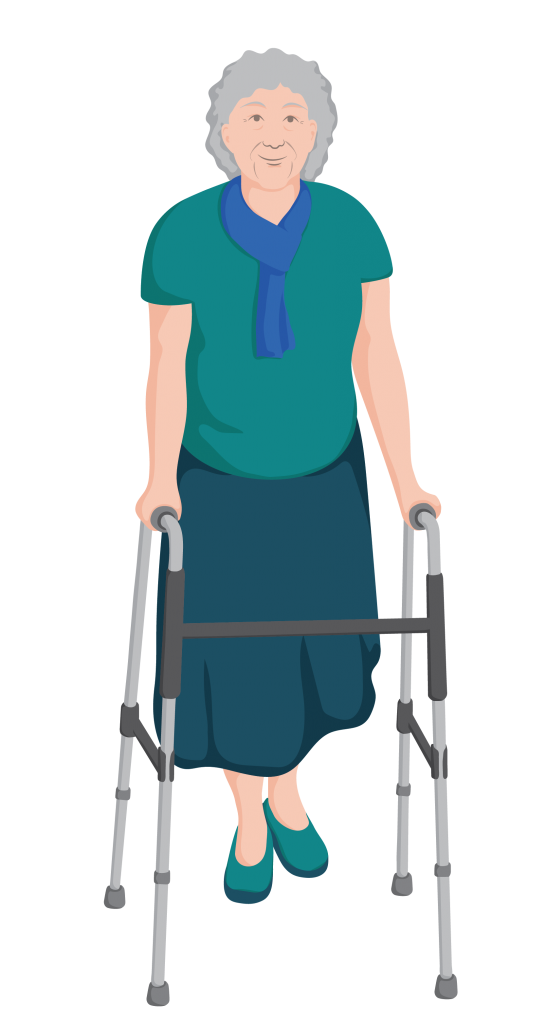
Meet Cali
Cali has arthritis and often has pain in her hips and knees when walking.
Cali uses a walking frame when walking short distances indoors.
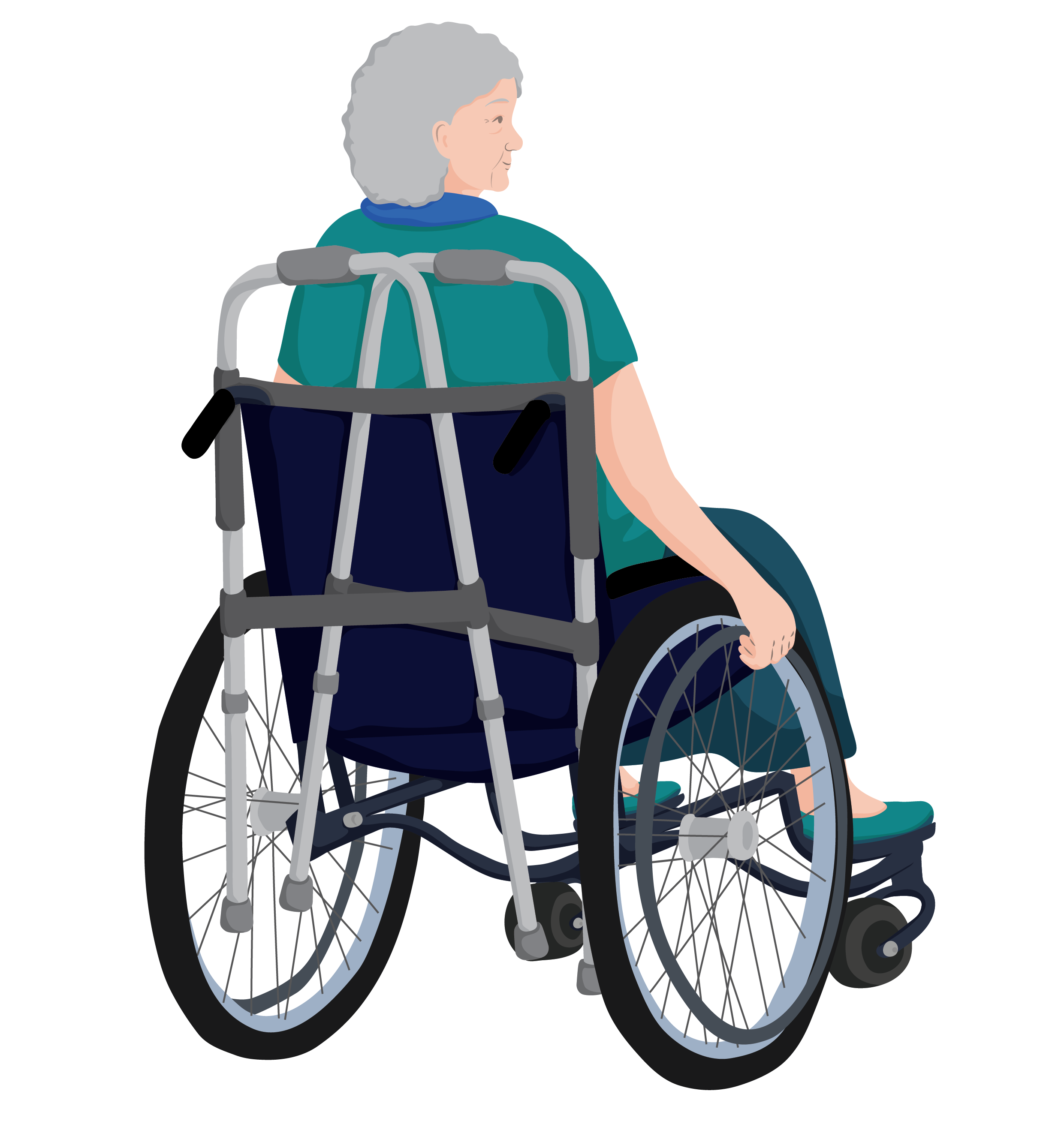
Cali uses a wheelchair to assist her mobility outdoors.

Type of wheelchair use
If a person will benefit from using a wheelchair, it is important to know whether they need the wheelchair for their short or long term use.
Question
Does Cali have difficulty walking outdoors short or long term?
Long term is correct!
Cali has an ongoing health problem and will benefit from using a wheelchair to assist her mobility outdoors long term.

Remember Jalus?
Jalus has just had surgery and cannot walk. He needs a wheelchair and will learn to walk with prosthetic legs when his amputations heal.
It is important to work out with Jalus and the rehabilitation team whether he will benefit from a wheelchair for his short or long term use.
Question
Choose if the following statements are true or false.
1. For longer distances it may take less energy and be faster for Jalus to use a wheelchair.
True is correct!
It takes a lot of energy to walk with prosthetic legs if a person has a double leg amputation. Many people prefer a combination of prosthetic legs for shorter distances and wheelchair for longer distances.
2. Providing a wheelchair for Jalus long term may take away his desire to walk.
False is correct!
Providing a wheelchair is not going to take away a person’s desire to walk. If a person is unsure about their mobility choices, encourage them to talk to peers with limb loss and rehabilitation professionals.
3. A person who has had a leg or both legs amputated needs a long term mobility solution.
True is correct!
When selecting a wheelchair, consider a person’s long term needs.
Provide a long term wheelchair that can be adjusted.
Environment
Find out where and how the person would like to use their wheelchair.
Mobility
Ask: Where would you like to use your wheelchair?
- Inside your home
- Around your community
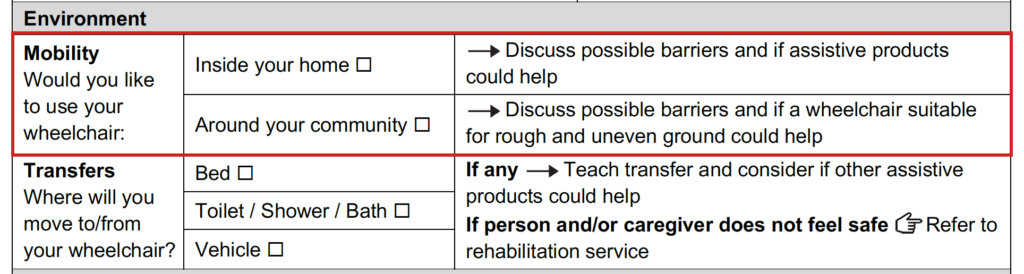
People may wish to use their wheelchair:
- Inside their home
- Around their community
- Both of these.
Barriers to mobility
The person’s environment can make mobility in a wheelchair more difficult.
Steps
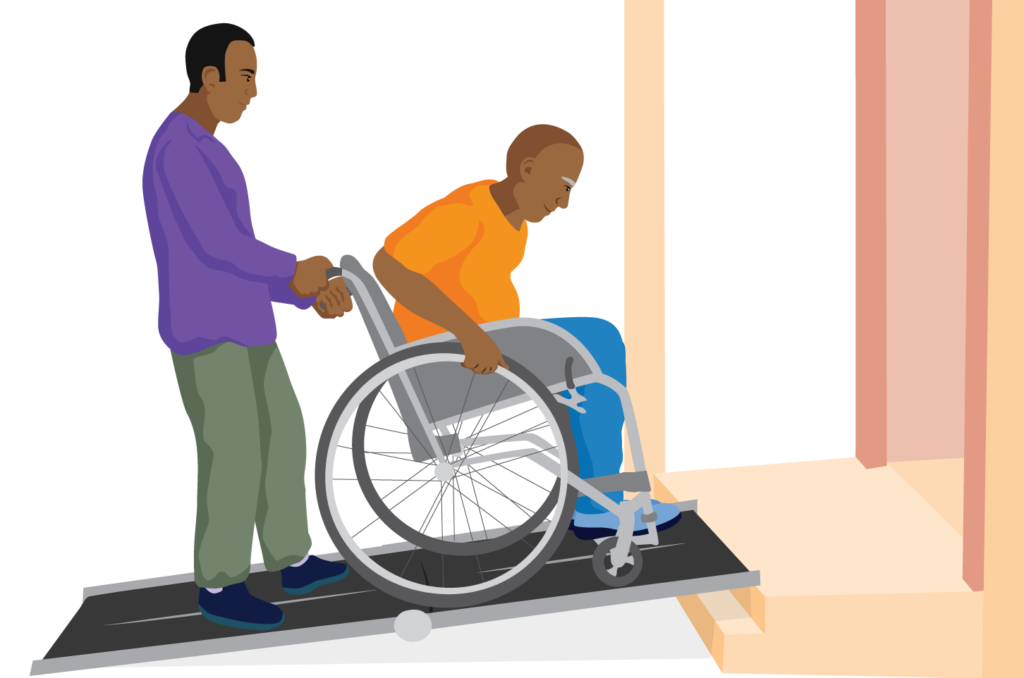
Portable ramps can assist access where there are:
- Steps when entering the home
- Steps inside the home.
Narrow doorways
The overall width of a wheelchair must be less than the width of the doorway. A well fitting wheelchair (without extra width) can help.
Rough ground
If the paths and roads are rough and uneven, a wheelchair suitable for rough ground can help.
TAP does not include changes to streets and buildings to improve access.
Transfers
Ask: Where will you move to/from your wheelchair?
- Bed
- Toilet/Shower/Bath
- Vehicle
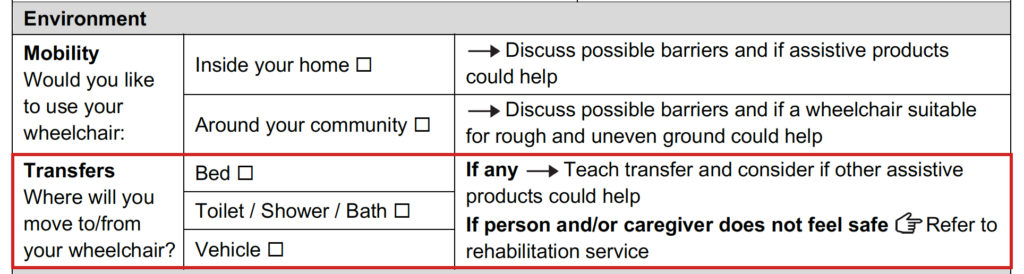
Find out where the person will transfer.
Transfers are easier when the transfer surfaces are the same height.
Teach transfers and consider if other assistive products could help.
Question
1. What can help if the person is having difficulty transferring to the bed because it is too high?
Select all that apply.
If you selected a, you are correct!
Cutting down the bed legs can reduce the height of the bed and make transfers easier.
b and c are incorrect.
Adding blocks under the bed legs is helpful if the bed is too low. It is not likely that the covers will make much difference to the height.
2. Which assistive products can make transfers to and from the toilet easier?
Select all that apply.
If you selected a, b and c, you are correct!
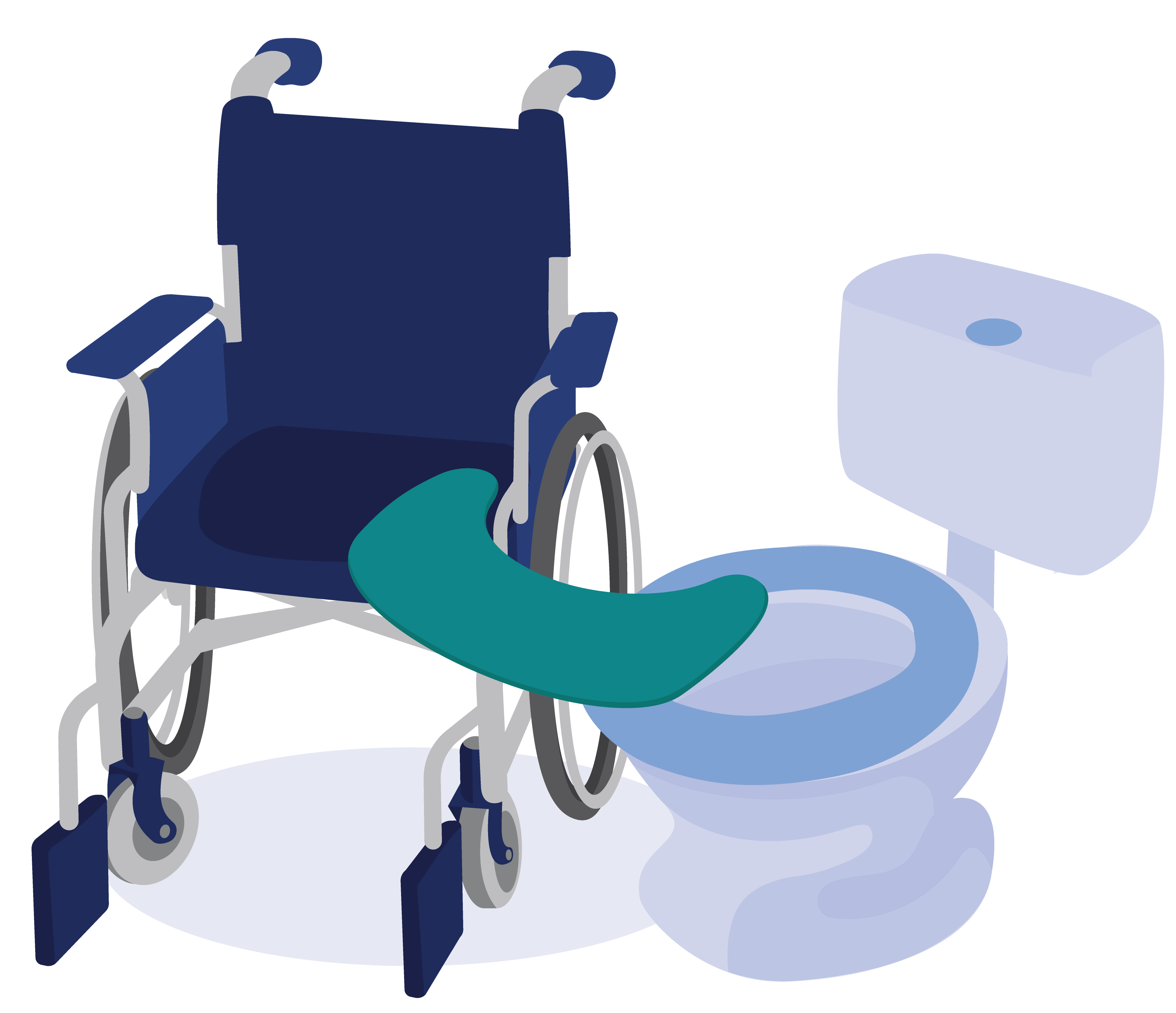
Transfer boards can help a person who has difficulty moving from wheelchair to toilet in one lift.
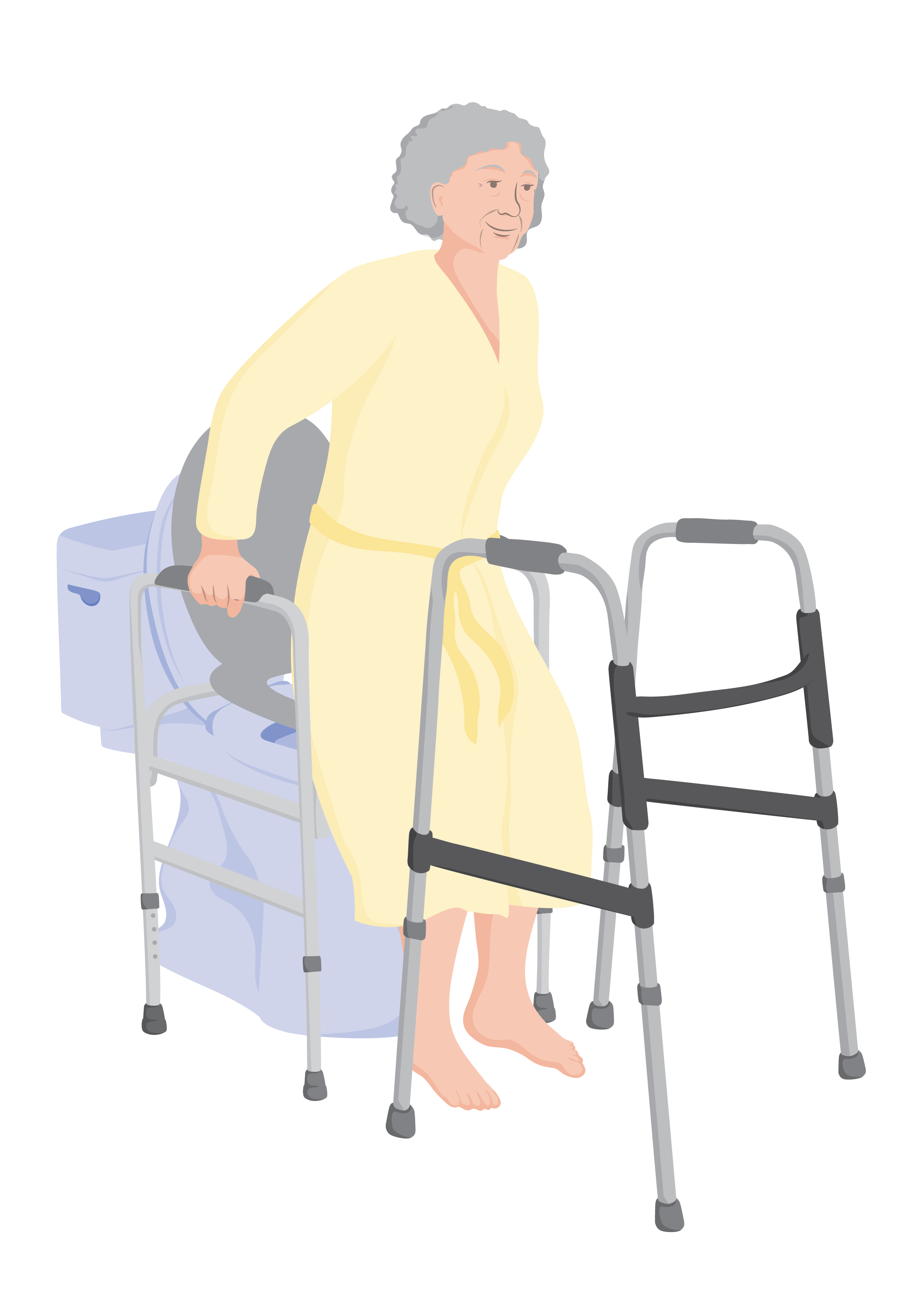
 Grab bars can help if a person has difficulty with balance.
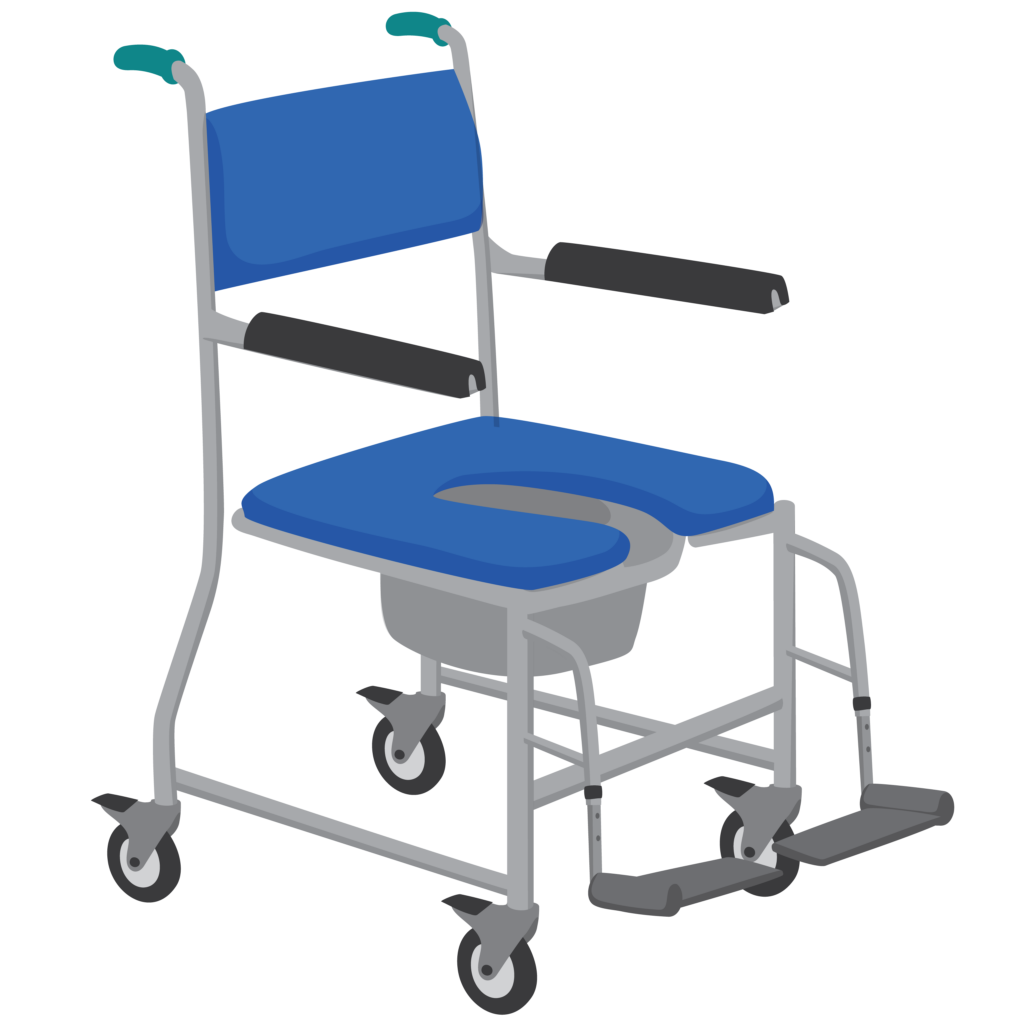
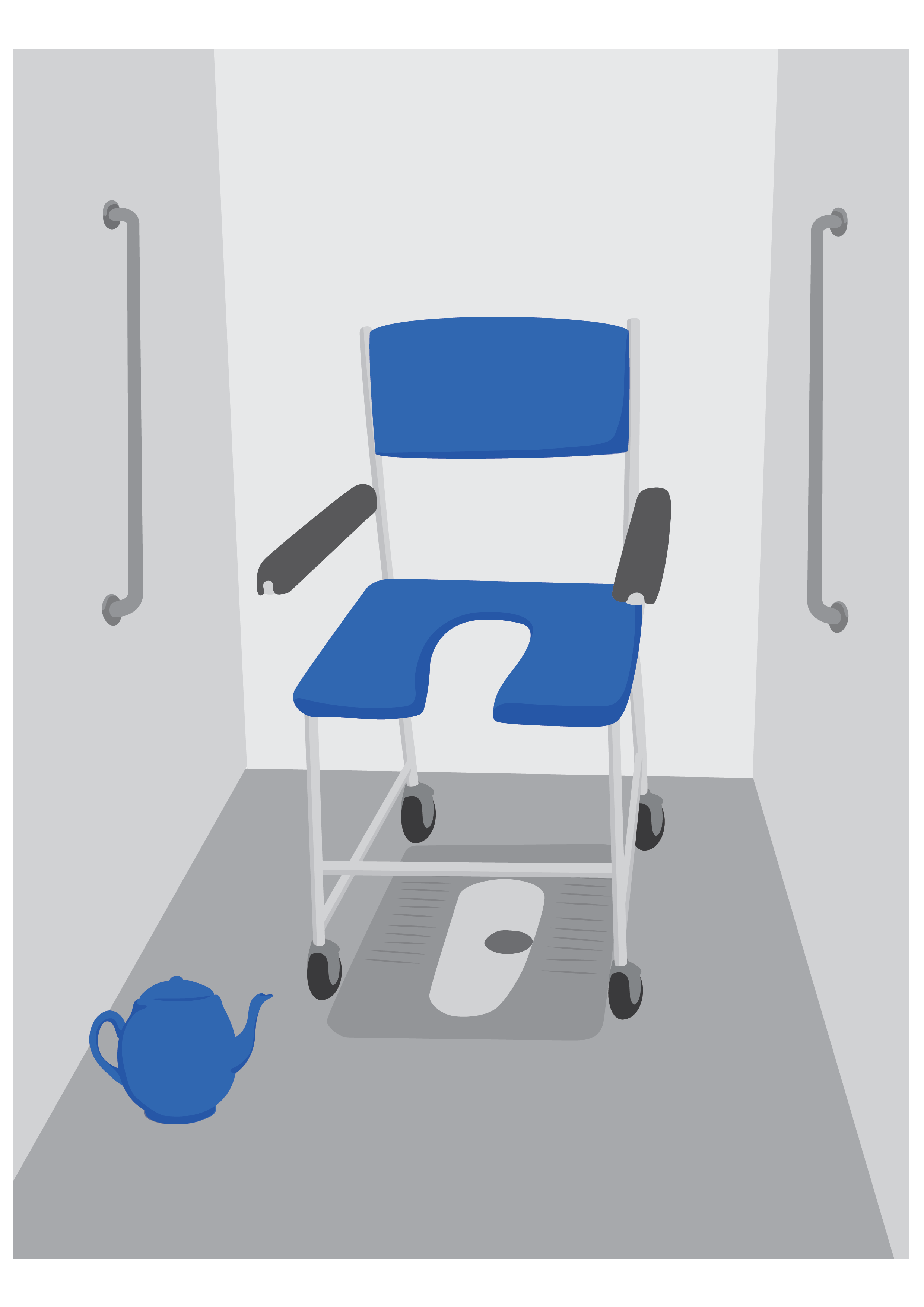 Toilet chairs can adjust the height of the toilet to make the transfer easier.
 If the bathroom is not accessible, a portable toilet chair positioned in a private place can help.
If a person and/or caregiver does not feel safe when transferring refer to a rehabilitation service.
To learn about how to make the environment more accessible, take the TAP Toilet and shower chairs module, TAP Portable ramps module and TAP Transfer boards module.
For people who already have a wheelchair
Ask:
- Does the wheelchair suit you and your needs?
- Is the wheelchair correctly fitted?
- Is the wheelchair in good working order?

If the person already has a wheelchair, ask them questions to find out if the wheelchair is suitable for their needs.
If it is not suitable, you should assess them for a new wheelchair or consider providing spare parts or repairs.
Simple health and sitting ability checks
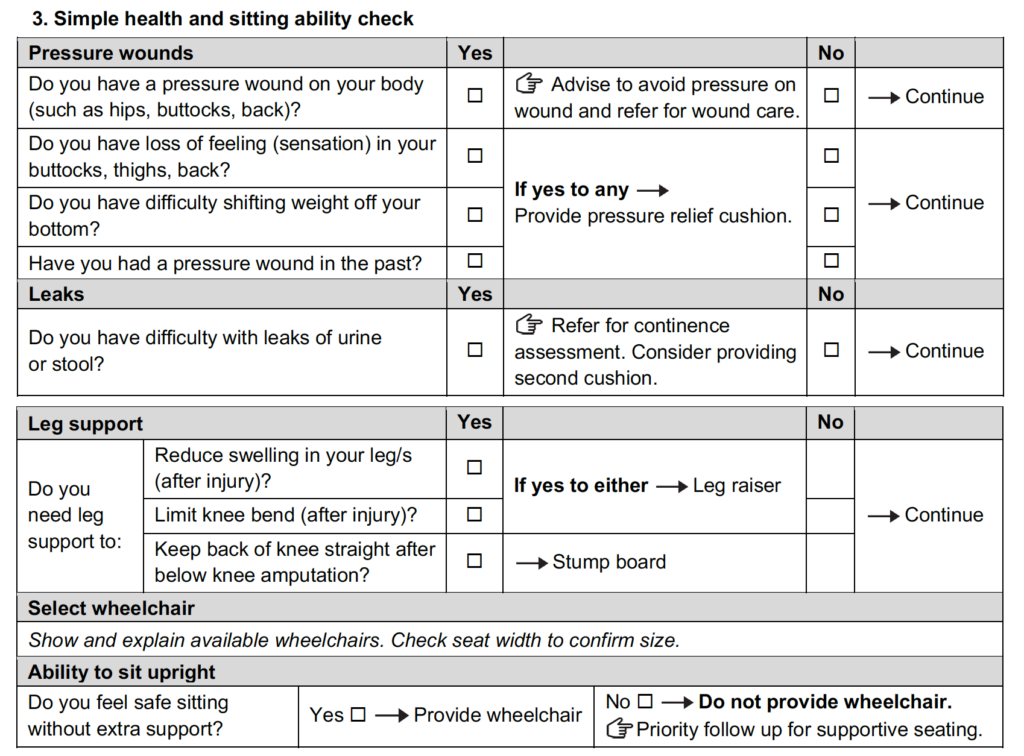
When selecting a suitable wheelchair, it is important to find out if a person requires extra:
- Skin protection when sitting on a cushion
- Support to sit safely and comfortably in a wheelchair.
Pressure wounds
Ask: Do you have a pressure wound on your body (such as hips, buttocks, back?)

If a person has an existing pressure wound on a part of their body which would touch the wheelchair this is a serious health risk.
Sitting in a wheelchair could make it worse.
- Refer the person for wound care
- Advise the person to avoid pressure on the wound.
Risk of developing pressure wounds
Ask the following questions to find out if a person is at risk of pressure wounds:
- Do you have loss of feeling (sensation) in your hips, buttocks, back?
- Do you have difficulty shifting weight off your bottom?
- Have you had a pressure wound in the past?
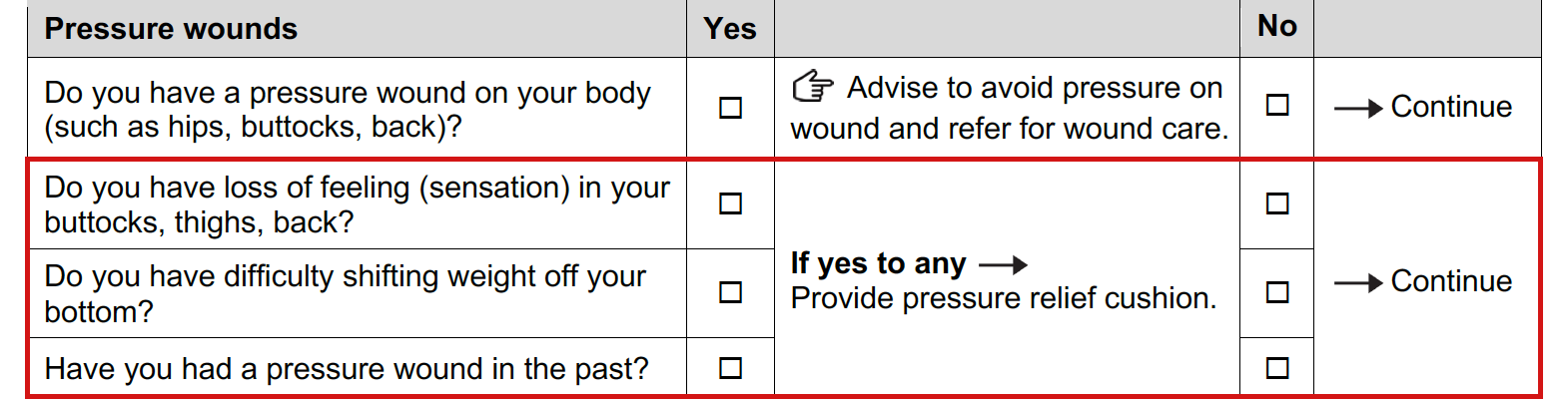
Some people are at risk of developing pressure wounds. If a person has any risk of pressure wounds, provide a pressure relief cushion.
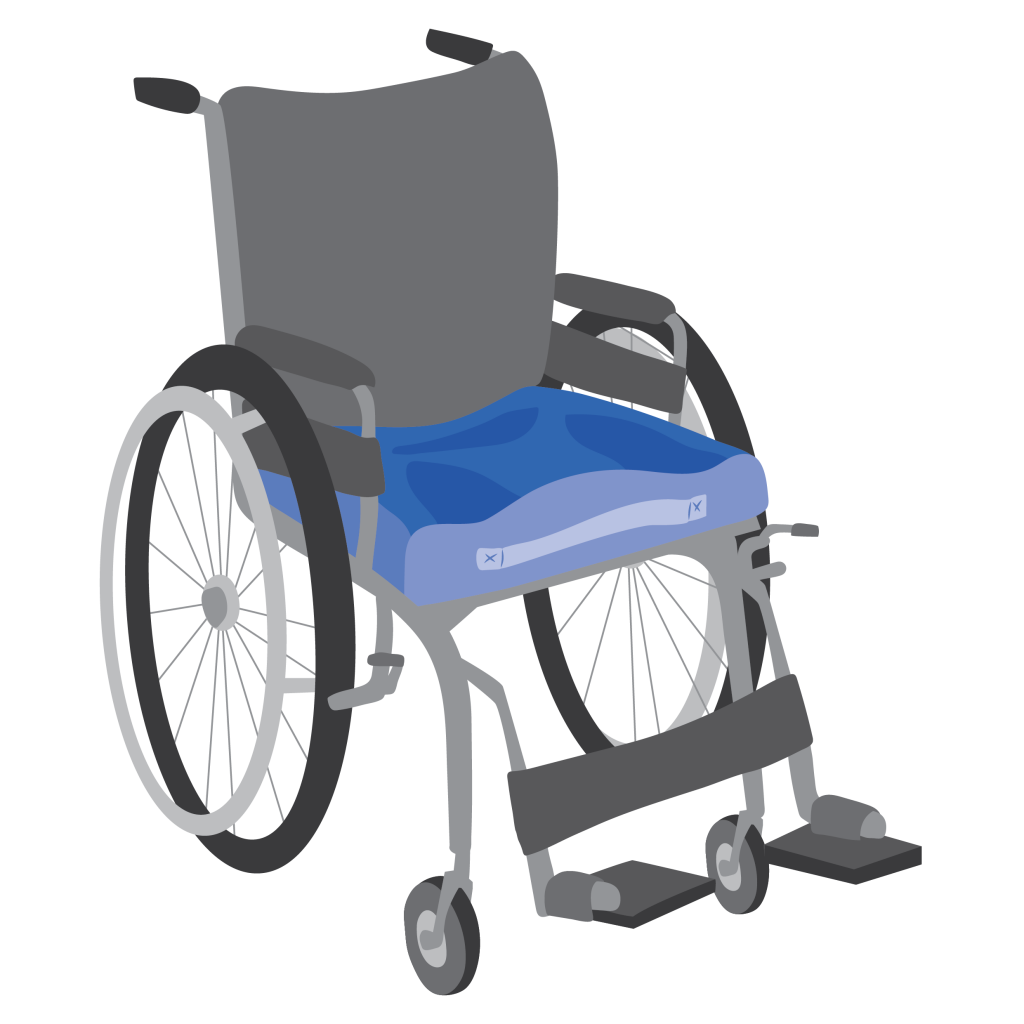
You will learn more about teaching a person how to avoid pressure wounds in Lesson four.
Question
Which of the people below are at risk of developing pressure wounds?
Select all that apply.
If you selected a and c, you are correct!
Verna is frail and has difficulty shifting weight off her bottom. Peter has loss of feeling (sensation) in his hips and buttocks. They are both at risk of pressure wounds and should be provided with a pressure relief cushion.
b is incorrect.
Jalus is not at risk of pressure wounds. He has full feeling (sensation) and is able to move and change position. Jalus will use a comfort cushion.
Bladder / bowel leaks
Ask: Do you have difficulty with leaks of urine or stool?

If a person experiences leaks from their bladder or bowel, their cushion may get wet or soiled.
Refer the person for continence assessment and advice on treatment or management.
Continence products can assist by protecting their clothes and wheelchair. They also help maintain a person’s dignity and comfort by protecting their skin and reducing odour.
Consider providing two pressure relief cushions so one can be washed and drying whilst the other is being used.
Learn more about continence in the TAP Self care assistive products module.
Need for leg support
Ask:
Do you need leg support to:
- Reduce swelling in your leg/s after injury?
- Limit knee bend after injury?
- Keep back of knee straight after below knee amputation?

After an injury or surgery, a person may benefit from leg support to:
- Reduce swelling
- Limit knee bend (after injury).
A leg raiser attached to the wheelchair can help.
A person with a below knee amputation can also benefit from support behind their knee to:
- Reduce swelling
- Keep full movement at the back of the knee.
This is very important for a person with a below knee amputation to walk well with a prosthetic leg.
Question
Remember Jalus?
Jalus is 23 years old and had an above knee and below knee amputation after being injured in an earthquake.
What kind of leg support would Jalus benefit from?
If you selected d and e, you are correct!
Jalus will benefit from a stump board to support his leg and keep full movement at the back of his knee. His above knee amputation will be supported by the wheelchair cushion.
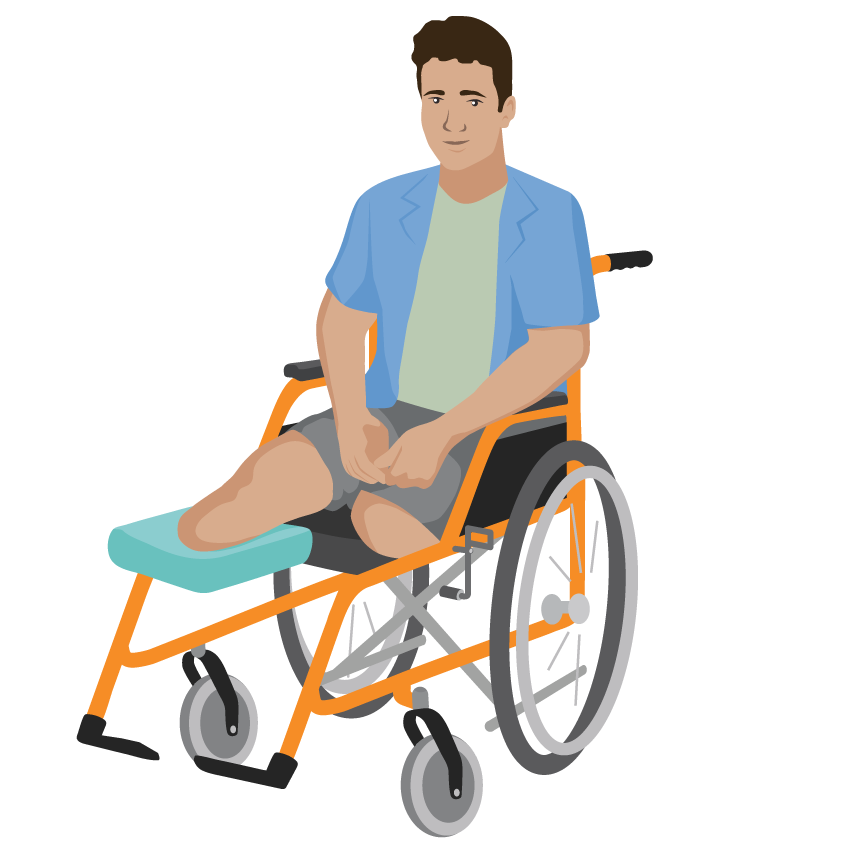
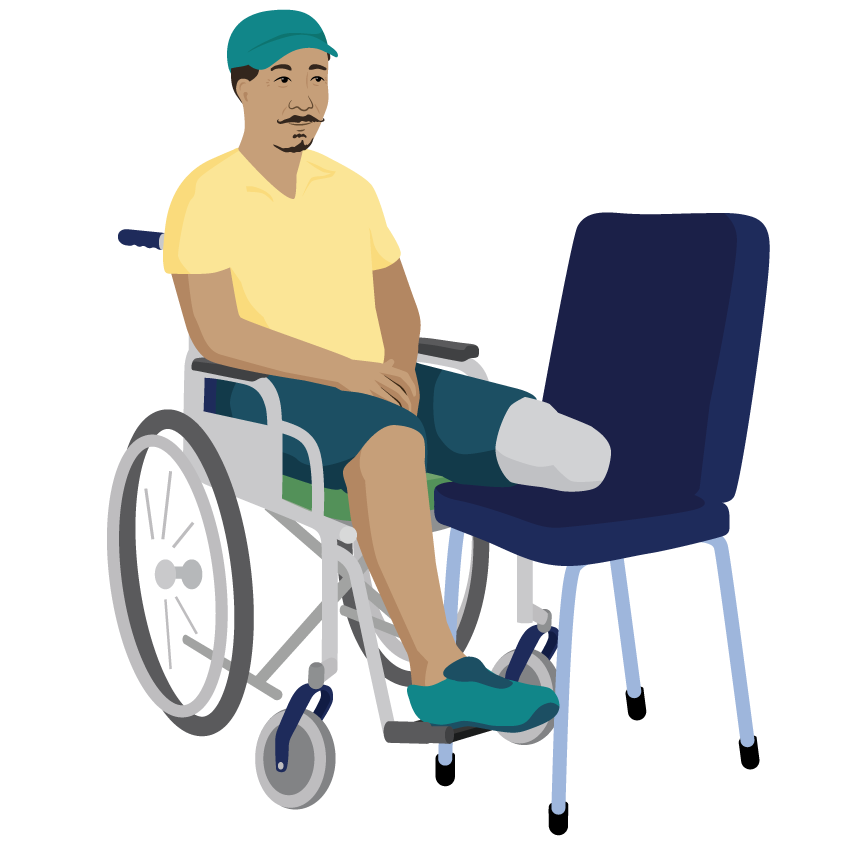
If no leg raisers or stump boards are available, a chair may be used to keep the person’s leg supported when not moving around.
Select wheelchair
Show and explain available wheelchairs to the person.
If temporary use and long term use wheelchairs are available, select the correct type of wheelchair for the person.
Explain that wheelchairs come in different sizes.
Remember that children need a child size wheelchair.
Select wheelchair width
Check seat width to confirm the suitable size of wheelchair.
Select the width that looks most suitable for the person, from the wheelchairs available.
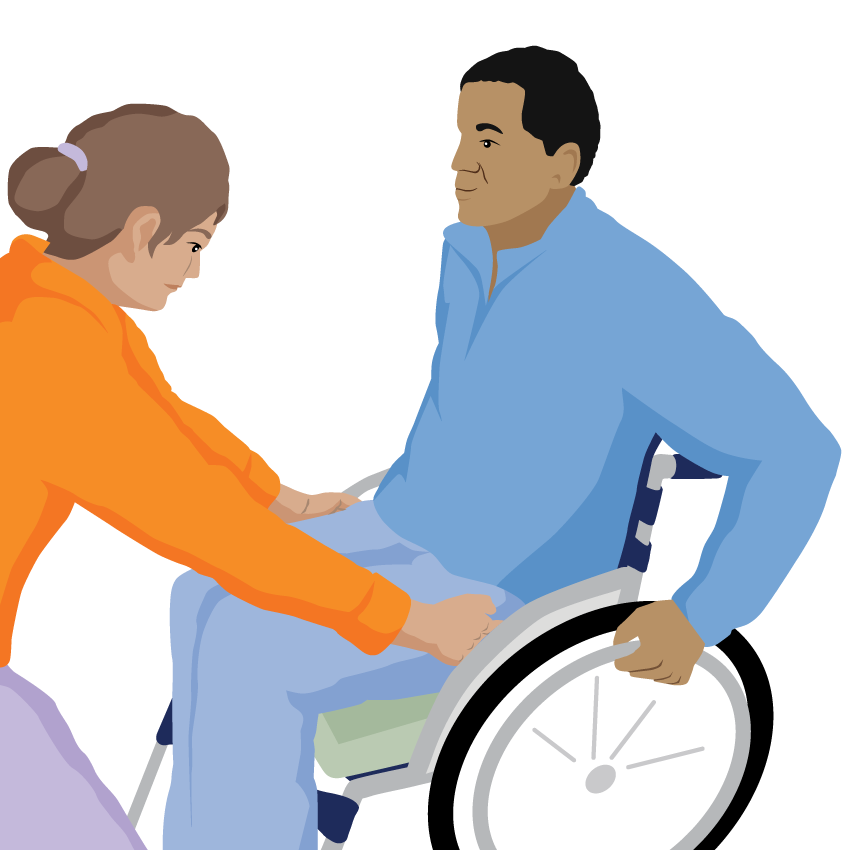
Explain to the person how to transfer into the selected wheelchair.
Check seat width
The correct width of wheelchair should fit the person closely:
- If the wheelchair is too large, select a smaller size
- If the wheelchair is too narrow, select a larger size.
Watch the video to learn how to select the correct width of wheelchair.
Activity
In pairs, one person should sit in a wheelchair and one person check the fit.
Select a suitable width of wheelchair. Then:
- Check the width
- If the width is not suitable, select a different size.
Did you have difficulty selecting the correct size of wheelchair?
Ability to sit upright
Ask: Do you feel safe sitting without extra support?

For a person’s health, safety, and comfort, it is important to check their ability to sit upright.
Difficulty sitting upright includes:
- Falling to the side
- Falling forward
- Sliding forward on the seat
- Difficulty sitting in the wheelchair because of strong uncontrolled movements.
If the person does not feel comfortable, or has difficulty sitting upright without using their arms for support, they may require more supportive seating. Note this in the plan.
If a person is available with the extra knowledge and skill to safely provide the extra support that the person needs, discuss referral for supportive seating.
If the person does not feel safe or is at risk of falling out of the wheelchair, do not provide the wheelchair.
Explain that it is not safe to provide the wheelchair. Take their contact details and record on a waiting list for priority follow up.
Question
Look at this person sitting in a wheelchair.

Are these statements true or false?
1. The person is sitting upright.
False is correct!
The person is leaning to one side.
2. The person is sitting with hips, back and shoulders central on the backrest.
False is correct!
The person is slipping forward and falling to one side. Their hips back and shoulders are not central on the backrest.
3. The person’s feet are flat and secure on the footrests.
False is correct!
The person is sliding forward and their feet are sliding off the footrests.
4. Does this person look comfortable or safe without extra support?
No is correct!
This person does not look comfortable or safe sitting without extra support. They are not able to sit upright and are holding on for support. Their feet are sliding off the footrests.
If they were provided with this wheelchair, they may slide out of it.
With their permission refer for supportive seating.
If this is not possible, explain that it is not safe to provide the wheelchair. Take their contact details and record on a waiting list for priority follow up.
You will learn more about follow up for supportive seating in Lesson five.