You have now completed all assessments and measurements to determine if it is suitable to provide the person with therapeutic footwear.
You can also plan your next steps with the person.
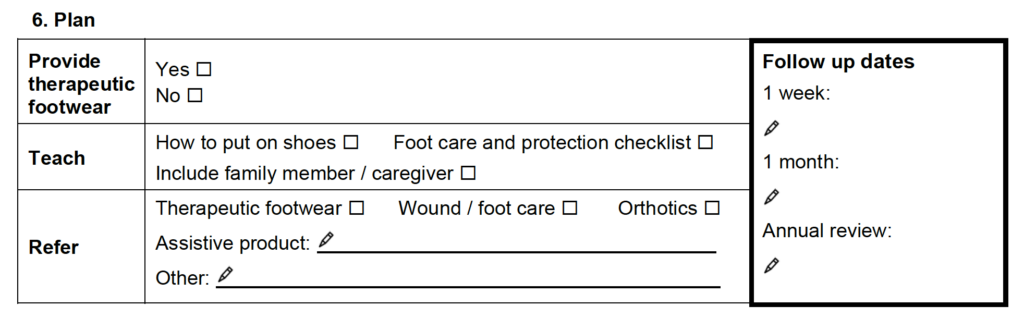
Provide therapeutic footwear
Use the information from the assessment to determine if it is appropriate to provide therapeutic footwear to the person.
If yes:
- Issue selected therapeutic footwear
- Refer to another service
- Teach education checklist
- Set follow up dates
If no:
- Refer to another service.
Teach
Based on the person’s assessment and selection, decide what would be useful to teach them about therapeutic footwear and foot care.
Involve the person’s family or caregiver where appropriate.
You will learn more about what to teach a person in the next lesson.
Refer
Referral to another service may be required.
Look back over the form and check if a referral was prompted by any part of the assessment or fitting process.
Wound care / foot clinic
Mark if the person needs:
- Wound management
- Further assessment of moderate and high risk feet.
Prosthetics and orthotics
Refer for prosthetic or orthotic assessment if the person has:
- An amputation but no prosthesis
- Feet that are not suitable for therapeutic footwear
- History of a wound or amputation.
Assistive product
This may include vision, mobility or self care assistive products.
Other
If the person has shown they would benefit from another referral, write this in.
Discussion
With your partner, compare your thoughts and questions about the TAP Therapeutic footwear assessment form.
Example talking points:
- What parts of the assessment are familiar to you
- What parts are new?
- Is the form clear or is more information needed?
- How long do you think doing an assessment using the form will take?
Follow up
Follow up is important to make sure that the therapeutic footwear is fitting well and meets the person’s needs.
Make a date with the person to follow up with them after both:
- One week
- One month.
They should also receive follow up every 12 months after the second follow up.
You will learn more about follow up in Lesson four.